



The French Revolution timeline runs primarily from 1789 to 1799, beginning with the political crisis around the Estates-General and ending with Napoleon Bonaparte’s coup of 18 Brumaire. In those ten years, France moved from an absolute monarchy to a constitutional monarchy, then a republic, through the Reign of Terror and the Directory, before Napoleon established the Consulate.
The Revolution did not develop in a straight line. Early reformers wanted constitutional government and legal equality, while later crises brought war, the fall of Louis XVI, political violence, emergency government, and repeated changes of regime.
French Revolution timeline at a glance
| Date | Event | Why it mattered |
|---|---|---|
| May 5, 1789 | Estates-General opens | Political crisis becomes a national confrontation |
| June 17, 1789 | National Assembly formed | Third Estate claims to represent the nation |
| June 20, 1789 | Tennis Court Oath | Deputies pledge to create a constitution |
| July 14, 1789 | Bastille stormed | Popular revolt becomes a symbol of revolution |
| August 4, 1789 | Feudal privileges abolished | Major legal foundations of the Old Regime are dismantled |
| August 26, 1789 | Declaration of Rights adopted | Liberty, equality, security, and political rights become revolutionary principles |
| October 5–6, 1789 | March on Versailles | Royal family moves to Paris |
| July 12, 1790 | Civil Constitution of the Clergy | Revolution transforms relations between church and state |
| June 20–21, 1791 | Flight to Varennes | King’s attempted escape damages trust in monarchy |
| September 3, 1791 | Constitution adopted | France becomes a constitutional monarchy |
| April 20, 1792 | France declares war on Austria | Revolutionary conflict becomes European war |
| August 10, 1792 | Tuileries stormed | Monarchy effectively collapses |
| September 21, 1792 | Monarchy abolished | France becomes a republic |
| January 21, 1793 | Louis XVI executed | Break with monarchy becomes irreversible |
| 1793–1794 | Reign of Terror | Emergency government and political repression intensify |
| October 16, 1793 | Marie Antoinette executed | Former queen is guillotined |
| February 4, 1794 | Slavery abolished in French colonies | Convention extends revolutionary equality into colonial law |
| July 27–28, 1794 | Robespierre falls and is executed | Terror loses its dominant political leadership |
| August 22, 1795 | Constitution of Year III | Framework for the Directory is adopted |
| 1795–1799 | Directory | Five-director republican government rules France |
| November 9, 1799 | Coup of 18 Brumaire | Napoleon topples the Directory |
France’s National Assembly itself presents the Revolution as a 1789–1799 sequence ending with Bonaparte’s November 1799 coup.
What caused the French Revolution?
The immediate crisis combined government debt, an unequal political and tax system, food hardship, and demands for political reform.
France entered the late 1780s with severe financial problems. Attempts to reform taxation repeatedly met resistance. Meanwhile, harvest problems and high food prices deepened public anger.
French society also operated through the three Estates: clergy, nobility, and everyone else. Political disputes over representation became especially important when Louis XVI summoned the Estates-General to address the financial crisis.
Enlightenment arguments about sovereignty, liberty, law, and representation created another intellectual challenge to the existing order.
Therefore, the Revolution did not begin because of a single riot or personality. It emerged from overlapping financial, social, political, and ideological crises.

1789: The French Revolution begins
1789 transformed a financial dispute into a revolution over political sovereignty and the social order.
May 5, 1789: Estates-General opens
Louis XVI convened the Estates-General at Versailles on May 5, 1789, bringing together representatives of the clergy, nobility, and Third Estate.
The assembly had not met since 1614.
However, disagreements quickly emerged over voting. The Third Estate wanted voting by individual deputy rather than by estate, since voting by three separate orders could allow the clergy and nobility to outvote it.
Versailles identifies the opening of the Estates-General as a crucial starting point for the Revolution.
June 17: Third Estate forms the National Assembly
On June 17, deputies of the Third Estate declared themselves the National Assembly, claiming political legitimacy as representatives of the French nation.
That step changed the central question.
The dispute was no longer simply about tax reform. It became a struggle over where sovereignty belonged: with the monarch or with the nation represented by deputies.
June 20: Tennis Court Oath
Three days later, deputies found their normal meeting place unavailable and gathered in a nearby jeu de paume court.
They pledged not to separate until France had a constitution.
The Palace of Versailles calls the Tennis Court Oath a founding act of French democracy.
July 14: Storming of the Bastille
Parisian revolutionaries seized the Bastille on July 14, 1789.
The fortress held only seven prisoners at the time. Nevertheless, the Bastille represented royal authority and arbitrary imprisonment, giving its fall enormous symbolic power.
July 14 later became France’s national day.
July–August: The Great Fear
Meanwhile, panic spread through the countryside.
Rumors claimed that aristocrats had recruited armed bands to attack communities or destroy crops. Peasants armed themselves, attacked some manor houses, and destroyed documents recording feudal obligations.
The French National Assembly connects this Great Fear, which spread from roughly July 20 onward, with the political pressure that produced the dramatic reforms of August.
August 4: Feudal privileges dismantled
During the night of August 4, deputies moved to dismantle feudal and seigneurial privileges.
The decisions struck at the legal hierarchy of the Old Regime and became one of the Revolution’s most important social turning points.
August 26: Declaration of the Rights of Man and of the Citizen
On August 26, the Assembly adopted the Declaration of the Rights of Man and of the Citizen.
Its opening principles declared people free and equal in rights and identified liberty, property, security, and resistance to oppression as fundamental rights.
The document became one of the Revolution’s most enduring legacies.
October 5–6: Women march on Versailles
Food shortages and political tension remained intense.
On October 5, a crowd led largely by women traveled from Paris to Versailles. The following day, the royal family left Versailles for Paris and settled at the Tuileries Palace.
The move brought Louis XVI closer to revolutionary Paris and permanently ended Versailles’ role as the royal family’s residence.

1790: Revolution reshapes church and state
In 1790, revolutionary leaders increasingly turned political change into institutional reform.
One of the most divisive measures was the Civil Constitution of the Clergy, adopted on July 12.
The reform reorganized the Catholic Church in France and tied clergy more closely to the revolutionary state. Requirements concerning clerical allegiance then deepened religious and political divisions.
Meanwhile, the Festival of the Federation on July 14, 1790 celebrated an ideal of national unity on the first anniversary of the Bastille’s fall. France’s presidency describes the celebration as an attempt to unite the nation around the new political order.
However, that unity did not last.

1791: The constitutional monarchy fails
1791 produced France’s first written constitution, but the king’s attempted escape destroyed much of the trust needed to sustain the settlement.
June 20–21: Flight to Varennes
Louis XVI and his family attempted to leave Paris in June 1791.
Authorities stopped them at Varennes and returned them to the capital.
The attempted escape strengthened suspicions that the king opposed the Revolution and hoped to escape its constraints. Versailles confirms that the royal family fled on June 20 and was captured the following day.
September 3: Constitution of 1791
The Assembly adopted France’s first written Constitution on September 3, 1791.
It created a constitutional monarchy, recognizing national sovereignty while leaving executive authority with the king under constitutional limits.
The system proved short-lived.
Growing republican sentiment, economic unrest, distrust of Louis XVI, and international tensions pushed the Revolution into a more radical phase.
1792: War and the fall of the monarchy
1792 destroyed the constitutional monarchy and created the First French Republic.
April 20: France goes to war
France declared war on Austria on April 20, 1792.
Foreign war dramatically increased domestic political pressure. Revolutionaries feared counterrevolution, foreign invasion, and connections between France’s enemies and supporters of the monarchy.
August 10: Tuileries Palace stormed
On August 10, insurgents attacked the Tuileries Palace in Paris.
The king lost effective power and the royal family entered confinement.
France’s National Assembly identifies the suspension of Louis XVI on August 10 as the event that led to the election of a new National Convention.
September: Massacres and Valmy
In early September, fear of foreign invasion and counterrevolution contributed to the September Massacres, during which prisoners in Paris were killed without normal judicial proceedings.
Then, on September 20, French forces stopped an invading army at the Battle of Valmy.
The political transformation followed immediately.
September 21: Monarchy abolished
The National Convention met and abolished royalty on September 21, 1792.
The next day became the beginning of Year I in the republican calendar.
France had become a republic.
1793: Louis XVI dies and the Terror intensifies
1793 brought execution, civil war, foreign war, economic instability, and increasingly exceptional government.
January 21: Execution of Louis XVI
The Convention tried Louis XVI and found him guilty.
He was guillotined on January 21, 1793 in Paris.
The execution intensified the conflict between revolutionary France and European monarchies.
Spring 1793: Committee of Public Safety
With France facing military threats and internal uprisings, the Convention created the Committee of Public Safety in April.
The government also confronted rebellion in the Vendée, federalist resistance, shortages, inflation, and foreign coalition warfare. The French National Archives records these pressures as central to the emergency political system that developed during 1793.
September 1793: Reign of Terror
The phase commonly called the Reign of Terror intensified in September 1793.
Revolutionary authorities used extraordinary courts, surveillance, arrests, economic controls, and executions against suspected enemies.
The Law of Suspects, adopted September 17, expanded the machinery for detaining alleged opponents.
October 16: Marie Antoinette executed
After imprisonment and trial, former queen Marie Antoinette was guillotined on October 16, 1793.
The Palace of Versailles confirms the date and her execution in what is now the Place de la Concorde.
1794: Abolition, political purges and Thermidor
1794 marked both the height of radical revolutionary government and its dramatic collapse.
February 4: Slavery abolished
On February 4, 1794, the National Convention abolished slavery in the French colonies and extended citizenship rights without distinction of color.
The measure became the first nationwide French abolition of slavery, although Napoleon later reversed it in 1802.
April 5: Danton executed
Georges Danton and several allies were guillotined in April.
Their deaths illustrated how revolutionary factions increasingly turned against former allies as political struggles intensified.
July 27–28: Fall of Robespierre
On July 27, 1794—9 Thermidor, Year II—Robespierre and his allies were arrested.
Robespierre was executed the following day.
The Bibliothèque nationale de France describes his fall as the end of the Terror’s dominant political phase.
The aftermath became known as the Thermidorian Reaction, as political power shifted away from the radical system associated with the previous year.
1795: The Directory begins
In 1795, revolutionary leaders built a more conservative republic designed to prevent both dictatorship and a return to radical Terror.
The Constitution of Year III was adopted on August 22, 1795.
It established a two-house legislature and a collective executive of five Directors. It also restored a more restricted electoral system.
The resulting government became known as the Directory.
1795–1799: The Directory
The Directory governed during the Revolution’s final years.
It rejected both royal restoration and the radical political model of 1793–1794. However, the government faced economic instability, political conspiracies, electoral conflict, war, and repeated reliance on the military.
At the same time, French armies achieved major victories abroad.
One officer benefited especially from those successes: Napoleon Bonaparte.
His military reputation and political importance grew while confidence in the Directory declined.
1799: Napoleon ends the Directory
The French Revolution timeline usually ends in November 1799 with Napoleon Bonaparte’s seizure of power.
On November 9, 1799—18 Brumaire, Year VIII—Bonaparte participated in the coup that overthrew the Directory.
A new political system, the Consulate, replaced it, with Napoleon emerging as First Consul. France’s National Assembly presents the coup as the event that ended the Directory and opened the Consular regime.
Historians can debate whether revolutionary change truly “ended” on one date. Nevertheless, 1789–1799 remains the standard chronological framework for the French Revolution.
The main stages of the French Revolution
Understanding the Revolution becomes easier when its ten years are divided into political phases.
| Period | Main phase |
|---|---|
| 1789–1791 | National Assembly and constitutional reform |
| 1791–1792 | Constitutional monarchy |
| 1792–1793 | Fall of monarchy and creation of Republic |
| 1793–1794 | Radical Republic and Terror |
| 1794–1795 | Thermidorian Reaction |
| 1795–1799 | Directory |
| November 1799 | Coup of 18 Brumaire and Consulate |
This structure helps explain why the French Revolution was not one uprising but a sequence of governments, conflicts, reforms, and reactions.
Why was the French Revolution historically important?
The Revolution fundamentally changed French political institutions and social relationships.
It destroyed major structures of the Old Regime, challenged hereditary privilege, established national sovereignty as a core political idea, and produced the Declaration of the Rights of Man and of the Citizen.
However, its history also exposed serious contradictions.
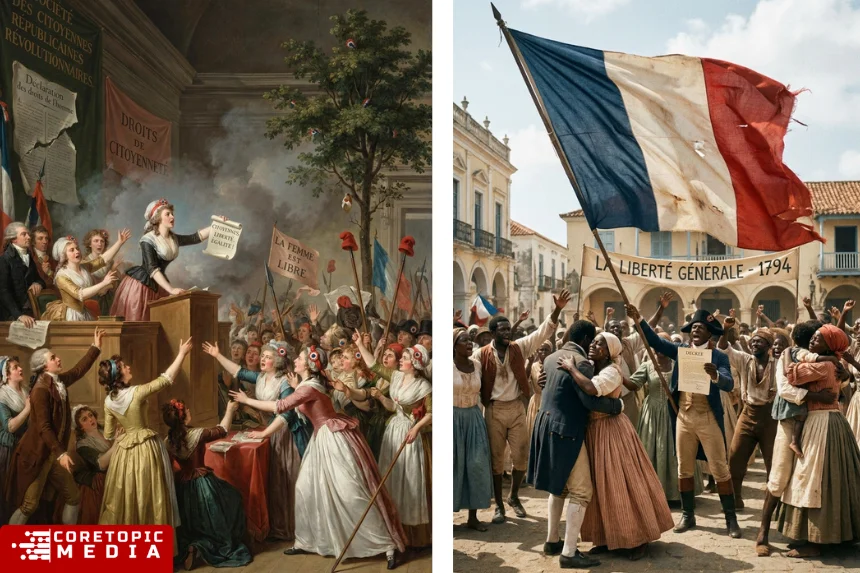
Women participated actively in revolutionary politics but did not receive equal political citizenship. Revolutionary France declared universal rights while colonial slavery continued until the Convention’s 1794 abolition—and Napoleon later restored slavery.
Likewise, a revolution begun in the language of liberty eventually produced emergency government, repression, war, and thousands of executions.
Therefore, its importance comes from both its ideals and its conflicts.
Frequently asked questions about the French Revolution timeline
1. When did the French Revolution start?
The French Revolution is generally dated from 1789. The Estates-General opened on May 5, while the National Assembly, Tennis Court Oath, and Storming of the Bastille rapidly transformed the crisis into revolution.
2. When did the French Revolution end?
The standard endpoint is November 9, 1799, when Napoleon Bonaparte’s coup of 18 Brumaire overthrew the Directory and led to the Consulate. However, historians can interpret the transition more broadly.
3. What happened on July 14, 1789?
Parisians stormed the Bastille, a royal fortress and prison that had become a symbol of arbitrary royal power. Consequently, July 14 became one of the Revolution’s defining dates.
4. What was the Tennis Court Oath?
On June 20, 1789, deputies pledged not to separate until France had a constitution. The oath asserted the National Assembly’s determination to act independently of royal pressure.
5. When did France become a constitutional monarchy?
France’s Constitution of September 3, 1791 created a constitutional monarchy and limited royal authority within a representative political system. Nevertheless, the arrangement collapsed the following year.
6. When did France become a republic?
The National Convention abolished the monarchy on September 21, 1792. The following day began Year I of the French Republic in revolutionary dating.
7. When was Louis XVI executed?
Louis XVI was guillotined on January 21, 1793, after the National Convention tried and condemned him. His execution made reconciliation with the old monarchy increasingly impossible.
8. When was the Reign of Terror?
The Reign of Terror is generally associated with 1793–1794, especially the emergency system that intensified from September 1793 until Robespierre’s fall in July 1794.
9. When did Robespierre die?
Robespierre fell from power on July 27, 1794, or 9 Thermidor, and authorities guillotined him on July 28, 1794. His fall marked a major political break in the Revolution.
10. How did Napoleon end the French Revolution?
Napoleon helped overthrow the Directory during the coup of 18 Brumaire on November 9, 1799. The new Consulate concentrated executive authority and began a new phase of French political history.
Conclusion
The French Revolution timeline from 1789 to 1799 charts an extraordinary decade of political change. The Estates-General led to the National Assembly and Tennis Court Oath; Parisian crowds stormed the Bastille; feudal privileges fell; and the Declaration of the Rights of Man announced new principles of liberty and equality.
However, constitutional monarchy failed. France abolished the monarchy in 1792, executed Louis XVI in 1793, endured the Terror, and overthrew Robespierre in 1794. The Directory then governed from 1795 until Napoleon Bonaparte toppled it in November 1799.
Therefore, the simplest chronology is:
1789: Revolution begins → 1791: constitutional monarchy → 1792: Republic → 1793–1794: Terror → 1795: Directory → 1799: Napoleon’s coup.
That sequence provides the core framework for understanding how France moved from the Old Regime into the revolutionary and Napoleonic eras.