


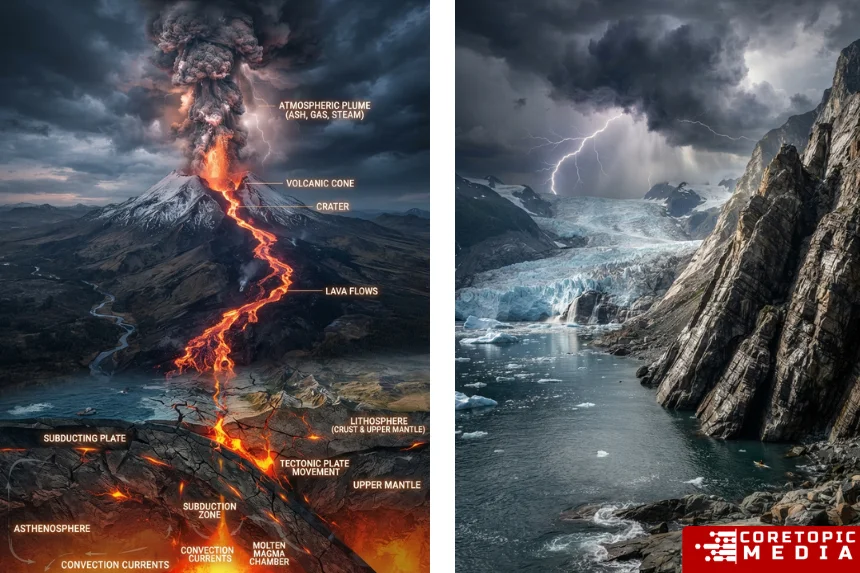
Earth science topics include geology, earthquakes, volcanoes, oceans, weather, climate, groundwater, glaciers, fossils, natural hazards, and Earth’s relationship with space. Students can use these subjects for research papers, science projects, presentations, essays, and classroom assignments.
However, the best topic depends on the assignment. Simple processes such as the rock cycle or water cycle work well for shorter projects, while groundwater depletion, climate feedbacks, earthquake hazards, ocean circulation, or satellite remote sensing provide stronger material for detailed research.
Modern scientists also study Earth as a connected system. The atmosphere, oceans, land, ice, water, and living organisms constantly interact. Therefore, many Earth science topics naturally overlap with physics, chemistry, biology, geography, and environmental science.
Quick answer: What are good earth science topics?
| Assignment | Good earth science topics |
|---|---|
| Easy project | Rock cycle, volcanoes, earthquakes, clouds |
| Middle school | Erosion, fossils, groundwater, tides |
| High school | Plate tectonics, climate, aquifers, hurricanes |
| Research paper | Sea-level rise, earthquake hazards, paleoclimate |
| Science fair | Soil erosion, water quality, weather patterns |
| Presentation | Volcanoes, glaciers, hurricanes, ocean currents |
| Environmental project | Drought, groundwater, wildfire, coastal erosion |
| Natural hazards | Earthquakes, volcanoes, floods, tsunamis |
| Technology | GIS, remote sensing, satellites, weather radar |
| Advanced research | Geophysics, geochemistry, climate modeling |
What does Earth science study?
Earth science examines Earth’s materials, structure, history, processes, and interacting systems.
Traditionally, students encounter geology, meteorology, oceanography, and Earth-space science. However, modern researchers also work in hydrology, geophysics, geochemistry, climate science, glaciology, soil science, and remote sensing.
NASA often describes Earth through interacting systems that include the atmosphere, biosphere, cryosphere, geosphere, and hydrosphere.
For example, ocean temperatures can change atmospheric circulation. Meanwhile, rainfall affects rivers and groundwater, vegetation influences the carbon cycle, and plate movement creates mountains, earthquakes, and volcanoes.
Therefore, Earth science provides many opportunities for interdisciplinary research.
100 earth science topics by category
The following ideas range from basic classroom subjects to advanced research questions.
Students can make any topic stronger by adding a location, time period, event, comparison, dataset, or specific scientific process.
Geology and plate tectonics topics
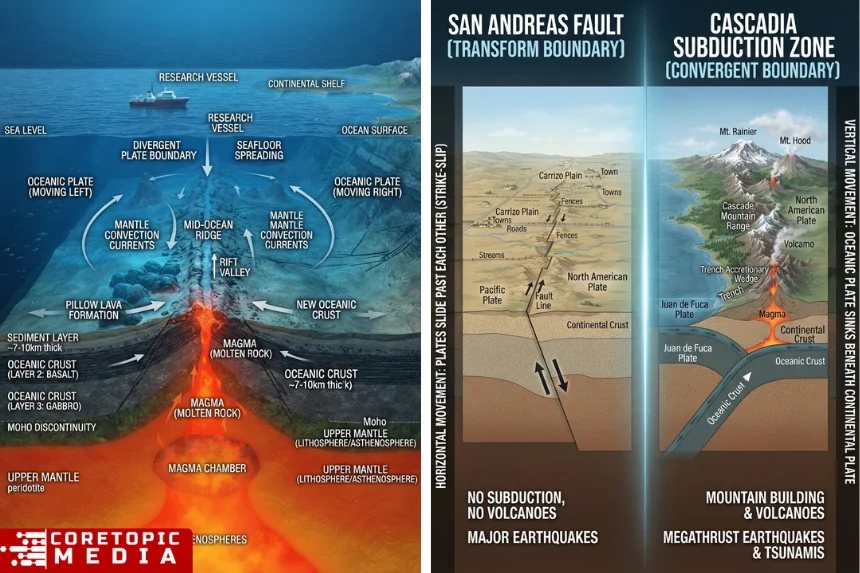
Plate tectonics provides one of the foundations of modern geology. Scientists use it to explain earthquakes, mountains, volcanoes, ocean basins, and the movement of continents.
- How plate tectonics changes Earth’s surface
- What causes tectonic plates to move
- How convergent boundaries create mountains
- Why earthquakes occur near plate boundaries
- How mid-ocean ridges create new crust
- Continental drift and evidence for Pangaea
- How subduction zones create volcanoes
- Transform faults and the San Andreas Fault
- How folding and faulting deform rocks
- Differences between oceanic and continental crust
A stronger research project could compare two plate boundaries instead of explaining plate tectonics in general.
For example, a student could compare earthquakes along California’s transform boundary with volcanoes near the Cascadia subduction zone.
Rocks, minerals, and Earth materials topics
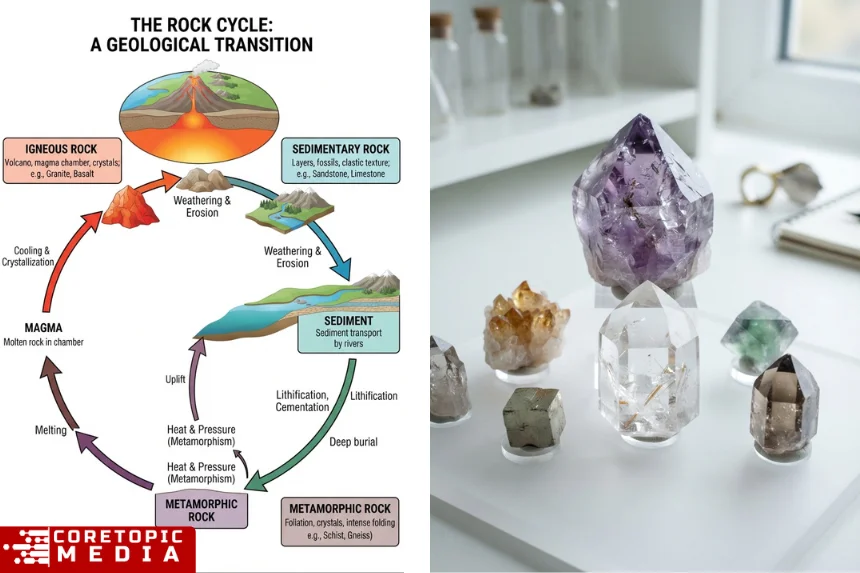
Rocks and minerals preserve evidence of Earth’s physical and chemical history.
- How the rock cycle works
- Igneous, sedimentary, and metamorphic rocks
- How magma composition affects volcanic rocks
- How sedimentary rocks preserve environmental history
- How heat and pressure change rocks
- How scientists identify minerals
- Crystal formation and mineral structure
- Physical and chemical weathering
- Minerals used in modern technology
- How geology influences construction materials
Students can make these topics interactive by testing hardness, streak, cleavage, texture, or other mineral and rock properties.
Earthquake, volcano, and natural-hazard topics
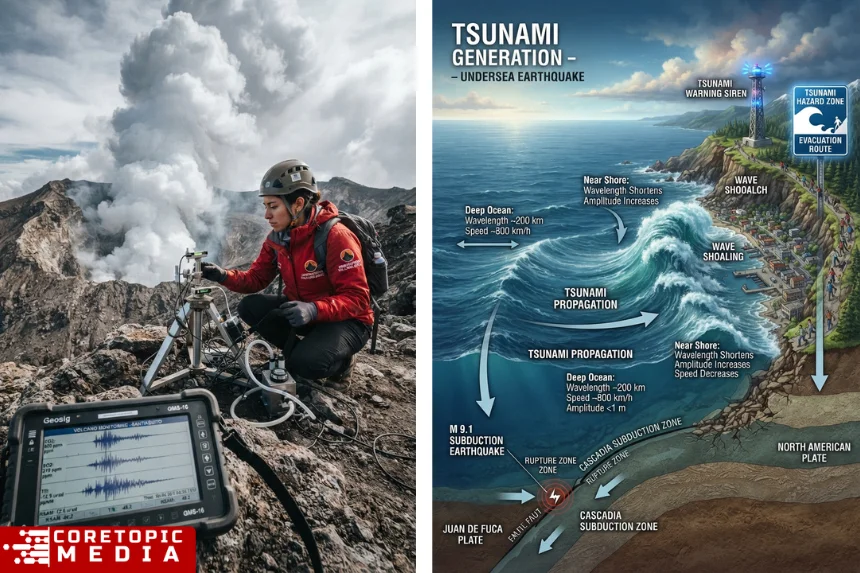
Natural hazards make excellent earth science topics because students can study both physical processes and their effects on communities.
- What causes earthquakes
- How seismic waves reveal Earth’s interior
- How scientists measure earthquake magnitude
- Earthquake early-warning systems
- Why aftershocks happen
- How volcanoes form
- Shield volcanoes versus stratovolcanoes
- How scientists monitor volcanic activity
- What causes tsunamis
- How communities reduce natural-hazard risk
The USGS Earthquake Hazards Program provides earthquake data, maps, monitoring information, and educational resources.
Students can also strengthen a paper by focusing on one event, such as the 1906 San Francisco earthquake or the 1980 eruption of Mount St. Helens.
Weather and atmospheric science topics
Atmospheric science studies the air surrounding Earth and the processes that create weather.
- How clouds form
- What causes thunderstorms
- How tornadoes develop
- How hurricanes gain energy
- How air pressure affects weather
- How jet streams influence weather
- Why precipitation varies between regions
- How meteorologists forecast severe weather
- How satellites track storms
- Why weather forecasts contain uncertainty
Weather topics work especially well for presentations because students can use satellite images, radar maps, storm tracks, and cloud diagrams.
Climate science topics
Climate science studies long-term patterns and interactions among Earth’s atmosphere, oceans, land, ice, and energy system.
- Weather versus climate
- How the greenhouse effect works
- How scientists reconstruct ancient climates
- How greenhouse gases affect Earth’s energy balance
- How ocean warming influences climate
- Why global sea level changes
- How glaciers respond to temperature changes
- Climate feedback loops
- How climate affects the water cycle
- Climate adaptation versus mitigation
Rather than choosing “climate change” as a broad research topic, students should focus on one process.
For example:
How does declining snowpack affect water availability in the western United States?
That question creates a much clearer research direction.
Oceanography topics
Oceanography combines physics, chemistry, geology, biology, and climate science.
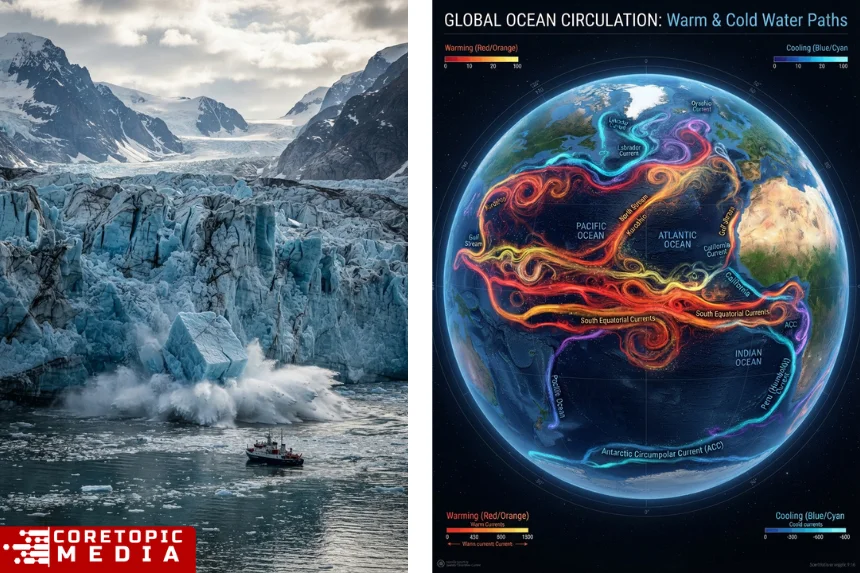
- How ocean currents transport heat
- Why ocean water is salty
- What causes tides
- How waves reshape coastlines
- How scientists map the seafloor
- Hydrothermal vents
- How El Niño affects weather
- Ocean acidification
- How satellites monitor oceans
- How sea-level rise affects coastlines
Students can explore authoritative materials through NOAA Ocean Service Education.
Ocean topics also work well for climate research because oceans store and transport huge amounts of heat.
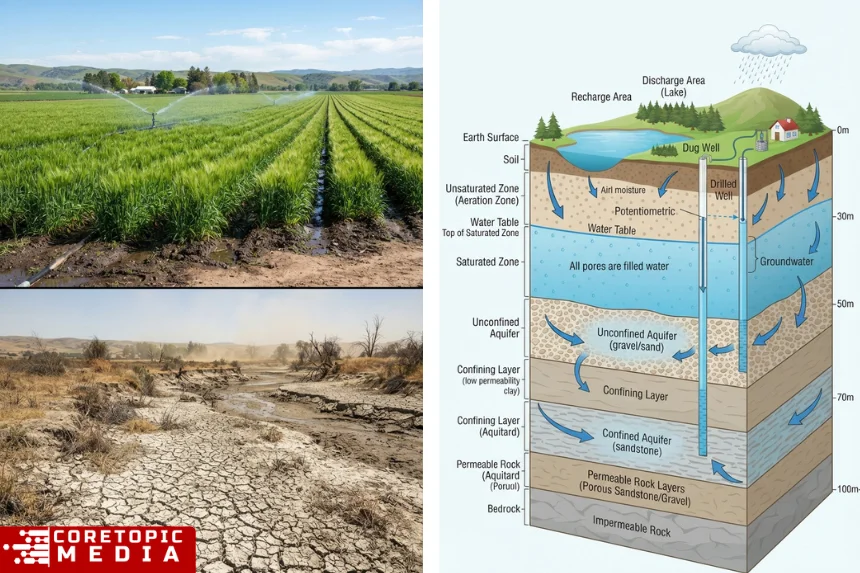
Water, groundwater, and hydrology topics
Hydrology studies water movement, storage, quality, and distribution.
- How the water cycle works
- How aquifers store groundwater
- What causes groundwater depletion
- How watersheds work
- How rivers transport sediment
- Why floods happen
- How drought develops
- How groundwater becomes contaminated
- How dams change rivers
- How soil moisture affects agriculture and drought
These topics work well for U.S. research projects because students can find extensive government data on rivers, reservoirs, groundwater, drought, and precipitation.
Glaciers, ice, and cryosphere topics
The cryosphere includes Earth’s frozen water.
- How glaciers form and move
- How glaciers carve valleys
- What ice cores reveal about past climate
- Why glaciers retreat and advance
- Sea ice versus land ice
- How land-ice melting affects sea level
- Permafrost and carbon cycling
- How snow affects Earth’s energy balance
- How glaciers leave deposits
- How satellites monitor ice
Satellite imagery makes glacier research especially useful for presentations and visual projects.
Students can compare historical and modern images of glaciers to study changes over time.
Fossils and Earth-history topics
Rocks and fossils allow scientists to reconstruct events that happened millions or billions of years ago.
- How fossils form
- How index fossils help date rocks
- Relative dating versus radiometric dating
- How scientists created the geologic time scale
- What rocks reveal about ancient environments
- Major mass extinctions
- How Earth’s atmosphere changed over time
- The formation and breakup of supercontinents
- How scientists determine Earth’s age
- What meteorites reveal about early Earth
Students can make these topics more analytical by studying evidence rather than simply describing historical events.
For example:
What evidence supports the asteroid-impact explanation for the end-Cretaceous extinction?
Soil, erosion, and landscape topics
Earth’s surface changes through erosion, weathering, sediment movement, biological processes, and human activity.
- How soil forms
- How soil horizons develop
- Chemical versus physical weathering
- How rivers form canyons
- How coastal erosion changes shorelines
- Why landslides happen
- How vegetation reduces erosion
- How sand dunes form
- How glaciers, rivers, and wind create landforms
- How human land use changes Earth’s surface
These subjects often work well for science fairs because students can design small experiments involving soil, water flow, vegetation, or erosion.
What are the best earth science topics for research papers?
Good research-paper topics focus on a specific question rather than an entire scientific field.
For example:
Too broad: Earthquakes
Better: Earthquake hazards
Strong research question: How does fault type influence earthquake patterns in California?
Similarly:
Too broad: Climate
Better: Snowpack and climate
Strong research question: How does declining snowpack affect summer water supply in the western United States?
Another example:
Too broad: Oceans
Better: El Niño
Strong research question: How does El Niño influence winter precipitation across the United States?
Focused questions make it easier to find evidence and build an organized argument.
Best earth science topics for presentations
Topics with strong visuals usually work best for presentations.
Good options include:
- Plate tectonics
- Volcanoes
- Earthquakes
- Hurricanes
- Tsunamis
- Glaciers
- Ocean currents
- Rock cycle
- River erosion
- Weather satellites
For example, the National Park Service plate tectonics guide explains how tectonic movement connects with earthquakes, mountains, volcanoes, and ocean basins.
Meanwhile, NASA provides satellite imagery and visualizations for storms, wildfire, ice, oceans, vegetation, and other Earth-system processes.
Easy earth science topics for students
Students who need a simple project should choose one clear process.
Good beginner topics include:
- Water cycle
- Rock cycle
- Volcano formation
- Earthquake causes
- Cloud formation
- Soil layers
- Fossils
- Tides
- Erosion
- Earth’s internal layers
However, students can make even an easy topic more interesting.
For example, instead of simply explaining erosion, a science-fair project could compare soil erosion with and without vegetation.
Similarly, students could investigate how temperature changes evaporation rates rather than only describing the water cycle.
Earth science topics for high school
High-school students can handle subjects that require several interacting processes.
Strong options include:
- Plate tectonics
- Earthquake early warning
- Groundwater depletion
- Climate feedbacks
- Hurricanes
- Sea-level rise
- Glaciers
- Fossil evidence
- Ocean circulation
- Wildfire and climate
- Drought
- Water quality
- Remote sensing
Many of these subjects also align with the Next Generation Science Standards, which include Earth systems, climate, natural resources, hazards, Earth history, and human sustainability.
Advanced Earth science research topics
College students can study topics that require modeling, quantitative analysis, geochemistry, remote sensing, or interdisciplinary thinking.
Examples include:
- Mantle convection
- Geodynamics
- Isotope geochemistry
- Paleoclimate reconstruction
- Hydrogeology
- Biogeochemistry
- Carbon cycling
- Sea-level modeling
- Climate feedback analysis
- Remote sensing
- GIS
- Satellite hydrology
- Ocean-atmosphere interactions
- Cryosphere modeling
- Earth-system simulations
Advanced research should examine not only what happens but also how scientists measure or model the process.
For example, instead of researching glacier loss generally, students could examine how satellite observations measure glacier-area changes over several decades.
Modern earth science topics
Technology has created many newer Earth science research areas.
Some strong modern topics include:
- Satellite remote sensing
- Geographic information systems
- Climate modeling
- Machine learning in weather forecasting
- Earthquake early warning
- Satellite groundwater monitoring
- Wildfire detection
- Coastal mapping
- Sea-level measurements
- Soil moisture satellites
- Carbon monitoring
- Drone-based geological surveys
NASA’s Earth Science focus areas offer examples of research involving storms, drought, volcanoes, ice, vegetation, oceans, wildfire, and climate.
How do you choose a good Earth science topic?
Start with a subject that interests you. Then narrow it until you can answer one main question within the assignment’s length.
For example:
Too broad: Natural disasters
Better: Earthquakes
Stronger: How does earthquake early warning work in California?
Another example:
Too broad: Water
Better: Groundwater
Stronger: How does drought affect groundwater levels in California’s Central Valley?
Next, check whether reliable evidence exists.
Government agencies, universities, scientific organizations, and peer-reviewed journals usually provide stronger evidence than generic blogs.
Finally, match the topic with the assignment. A five-minute presentation should use a narrower and simpler question than a 20-page college research paper.
Where can students find reliable Earth science sources?
Students should begin with scientific agencies and educational institutions.
Useful sources include:
- NASA
- NOAA
- USGS
- National Park Service
- Universities
- Geological surveys
- Scientific journals
- Professional scientific societies
For earthquake research, the USGS Earthquake Hazards Program provides monitoring data, maps, hazard information, and scientific explanations.
For ocean projects, NOAA publishes extensive educational and observational resources.
NASA provides data on Earth’s atmosphere, oceans, land, water, ice, and climate from satellites and field research.
Students can also use the Earth science overview on Wikipedia to understand terminology and discover related fields. However, final research papers should cite primary scientific sources whenever possible.
Frequently asked questions about earth science topics
1. What are the main topics in Earth science?
Earth science includes geology, geophysics, meteorology, atmospheric science, oceanography, hydrology, climate science, glaciology, and Earth history. Moreover, modern researchers study interactions between these systems.
2. What are the four traditional branches of Earth science?
Many introductory courses emphasize geology, meteorology, oceanography, and astronomy or Earth-space science. However, modern Earth science includes many additional interdisciplinary fields.
3. What is an easy Earth science topic for a project?
The rock cycle, water cycle, volcanoes, earthquakes, erosion, clouds, and soil formation all work well. Therefore, beginners can focus on one clear process without needing advanced mathematics.
4. What are good Earth science topics for high school?
Plate tectonics, groundwater, earthquakes, climate feedbacks, hurricanes, glaciers, sea-level rise, and Earth history provide strong options. In addition, many align with U.S. NGSS standards.
5. What Earth science topics work for research papers?
Groundwater depletion, earthquake hazards, paleoclimate, ocean circulation, volcanic monitoring, coastal erosion, and climate feedbacks provide enough scientific evidence for deeper analysis.
6. Is climate change an Earth science topic?
Yes. Climate science examines interactions among the atmosphere, oceans, land, ice, energy, and living systems. Therefore, climate belongs firmly within Earth-system science.
7. Is astronomy part of Earth science?
Earth-space science includes Earth’s relationship with the Moon, Sun, solar system, and space environment. However, astronomy as a whole also covers subjects beyond Earth science, including stars, galaxies, and cosmology.
8. Are natural disasters part of Earth science?
Yes. Earth scientists study earthquakes, volcanoes, tsunamis, landslides, floods, storms, and other natural hazards. Moreover, this research helps communities understand and reduce risk.
9. What are modern Earth science topics?
Modern topics include remote sensing, GIS, climate modeling, satellite groundwater monitoring, earthquake early warning, wildfire observation, and carbon-cycle research.
10. How can I turn an Earth science topic into a research question?
Add a specific process, location, variable, comparison, or time period. For example, change “glaciers” into “How does glacier retreat affect summer river flow in Alaska?”
Conclusion
The best earth science topics combine an interesting scientific process with a focused question that students can investigate using reliable evidence.
Geology, weather, oceans, climate, groundwater, natural hazards, fossils, soil, glaciers, and Earth-space science all provide strong starting points. However, broad subjects usually produce weaker papers.
Instead of writing about “volcanoes,” investigate how scientists predict eruptions. Instead of studying “climate,” focus on drought, snowpack, sea-level change, or one climate feedback.
Ultimately, a focused question combined with trustworthy NASA, NOAA, USGS, university, or peer-reviewed evidence can turn a basic topic into a strong research paper, presentation, or science project.