


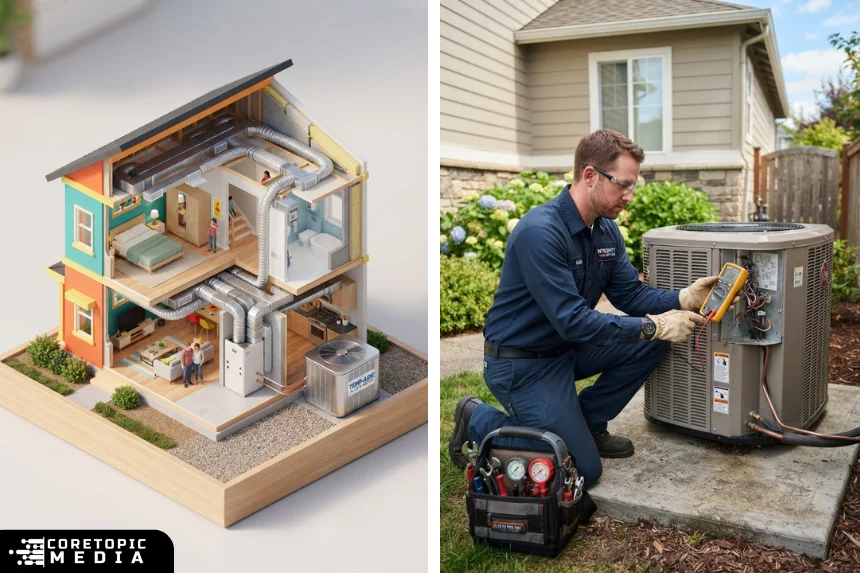
Knowing how to value a heating and air conditioning business is important if you want to sell, buy, raise capital, plan retirement, bring in a partner, or understand the strength of your company. A heating and air conditioning company is not valued only by its revenue. Buyers usually care more about profit, recurring service agreements, clean financial records, customer quality, technician depth, and how much the company depends on the owner.
The simple formula is:
Business value = normalized earnings × valuation multiple
For a smaller owner-operated HVAC business, buyers often use SDE, which means seller’s discretionary earnings. For a larger company with a management team, buyers usually use EBITDA, which means earnings before interest, taxes, depreciation, and amortization.
The final value depends on the quality of the business. A company with steady maintenance contracts, strong reviews, trained technicians, clean books, and low owner dependence can command a stronger multiple. A company with messy records, weak margins, old vehicles, customer concentration, or too much dependence on one owner may receive a lower valuation.
Quick Answer: How Do You Value an HVAC Business?
To value an HVAC business, start with the company’s real earnings, adjust those earnings for normal buyer expectations, choose the right valuation method, then apply a reasonable multiple.
The basic process looks like this:
- Gather financial records.
- Calculate SDE or EBITDA.
- Remove one-time or personal expenses.
- Review recurring revenue and customer quality.
- Choose a valuation multiple.
- Adjust for assets, debt, working capital, and risk.
- Compare the result with similar HVAC business sales.
A simple valuation formula looks like this:
| Business type | Common earnings measure | Simple formula |
|---|---|---|
| Small owner-operated HVAC company | SDE | SDE × multiple |
| Larger HVAC company | EBITDA | EBITDA × multiple |
| Asset-heavy or distressed company | Asset value | Assets minus liabilities |
| Fast-growing company | Future cash flow | Projected cash flow adjusted for risk |
Most healthy HVAC companies sell based on earnings, not just revenue. Revenue matters, but buyers want to know how much profit the company produces and how predictable that profit will be after the sale.
Find the real profit, multiply it by a realistic multiple, then adjust for risk, assets, debt, and growth quality.
What Makes HVAC Business Valuation Different?
Heating and air conditioning companies have special valuation factors because they provide essential services. People need heating in cold weather and cooling in hot weather, so demand can be steady. At the same time, the business can be seasonal, labor-heavy, and dependent on local reputation.
HVAC valuation is different because buyers look closely at:
- Seasonal revenue patterns
- Emergency repair demand
- Maintenance agreements
- Installation vs service revenue
- Residential vs commercial customers
- Technician availability
- Licensing requirements
- Vehicle and tool condition
- Dispatch and scheduling systems
- Customer reviews
- Local competition
- Owner involvement
- Gross margins
- Service area density
- Repeat customer base
A business that relies heavily on new installations may look profitable in a strong construction market, but buyers may discount it if those profits look less stable. A company with recurring maintenance plans and repeat service revenue often looks safer because buyers can forecast future cash flow more easily.
HVAC companies get valued differently because service mix, technicians, contracts, seasonality, and local reputation all affect future profit.
Step 1: Gather the Right Financial Records
A good valuation starts with clean financial information. If the books are messy, the buyer may not trust the earnings. When a buyer loses trust, the valuation usually drops.
Gather these records before estimating value:
- Profit and loss statements for the last three to five years
- Tax returns for the last three to five years
- Balance sheets
- Revenue by service line
- Gross margin by service type
- Payroll reports
- Owner compensation details
- Vehicle list
- Equipment and tool list
- Inventory records
- Maintenance agreement list
- Customer list
- Accounts receivable aging
- Debt schedule
- Lease agreements
- Vendor contracts
- Insurance records
- Licensing information
The cleaner your records are, the easier it becomes to prove your earnings. Buyers want to know whether the profit is real, repeatable, and transferable.
Clean financial records help buyers trust the business and support a stronger valuation.
Step 2: Calculate SDE or EBITDA
The next step is to calculate the right earnings number.
For smaller heating and air conditioning businesses, sellers often use SDE. SDE shows the total financial benefit one full-time owner-operator receives from the business.
SDE may include:
- Net profit
- Owner salary
- Owner benefits
- Personal expenses paid by the business
- One-time expenses
- Interest
- Depreciation
- Amortization
- Non-essential expenses
- Non-operating expenses
For larger HVAC companies, buyers often use EBITDA. EBITDA shows operating earnings before interest, taxes, depreciation, and amortization. It helps buyers compare the company with other businesses more easily.
EBITDA usually works better when the company has:
- A management team
- Less owner dependence
- Higher earnings
- Clear reporting
- Multiple crews
- Strong systems
- More professional operations
The right earnings number matters. If you use SDE for a company that buyers view as an EBITDA business, the value may look inflated. If you use EBITDA for a small owner-operated company, the value may look too low.
Use SDE for smaller owner-operated companies and EBITDA for larger, more professionally managed HVAC businesses.
Step 3: Normalize Earnings With Add-Backs
Normalized earnings show what the business should earn under normal ownership. This process removes unusual or personal expenses that will not continue after a sale.
Common add-backs include:
- Owner salary above market level
- Personal vehicle expenses
- One-time legal fees
- One-time repairs
- Non-recurring consulting costs
- Personal travel
- Owner health insurance
- Charitable donations not required for operations
- Family payroll for people who do not work in the business
- Non-business meals or entertainment
- Interest expense
- Depreciation and amortization
Add-backs must be reasonable. Buyers will challenge weak add-backs during due diligence. If the seller adds back too much, the buyer may lose confidence in the numbers.
A good add-back should answer this question:
Will this expense continue after the buyer owns the business?
If the answer is no, the expense may qualify as an add-back. If the answer is yes, the buyer will likely treat it as a normal operating cost.
Add-backs adjust earnings, but they must be real, documented, and easy for a buyer to understand.
Step 4: Choose the Right Valuation Method
There are several ways to value a heating and air conditioning business. The best method depends on company size, profit quality, assets, and sale purpose.
1. SDE Multiple Method
This method works well for smaller owner-operated companies. It calculates value by multiplying seller’s discretionary earnings by a market-based multiple.
Example:
SDE × multiple = estimated business value
This method works best when the buyer expects to replace the owner or operate the business directly.
2. EBITDA Multiple Method
This method works better for larger HVAC companies. It calculates value by multiplying EBITDA by a market-based multiple.
Example:
EBITDA × multiple = estimated enterprise value
This method works best when the business has a management team, larger earnings, and less owner dependence.
3. Discounted Cash Flow Method
This method estimates future cash flow and discounts it back to today’s value. It can work for larger companies with reliable forecasts.
This method depends heavily on assumptions, so small changes in growth rate or risk can change the result.
4. Comparable Sales Method
This method compares the business with similar HVAC companies that have sold. It can be useful, but private sale data can be hard to access.
5. Asset-Based Valuation
This method values the assets of the business after subtracting liabilities. It may apply to distressed companies or companies with weak earnings.
For most healthy HVAC businesses, asset-based valuation works better as a floor value than the main method.
6. Revenue Multiple Method
Revenue multiples can give a rough check, but they should not be the main method. Two companies with the same revenue can have very different profits.
Most HVAC companies are valued with SDE or EBITDA multiples, while DCF, comparable sales, and asset value support the final estimate.
Step 5: Apply a Realistic Valuation Multiple
The valuation multiple is the number applied to earnings. It reflects risk, growth, quality, and buyer demand.
Higher multiples usually go to companies with:
- Strong recurring revenue
- Clean books
- Good margins
- Low owner dependence
- Strong technician team
- Reliable dispatch systems
- High customer retention
- Good online reviews
- Low customer concentration
- Commercial service contracts
- Strong brand reputation
- Documented processes
- Growth potential
Lower multiples usually apply to companies with:
- Unstable earnings
- Heavy owner dependence
- Poor financial records
- Weak margins
- Old vehicles
- No maintenance contracts
- High employee turnover
- Too much new construction work
- Weak reviews
- Customer concentration
- Poor systems
- Declining sales
A multiple is not automatic. Buyers do not pay the same multiple for every HVAC company. They pay based on the risk and quality of the earnings.
A stronger, cleaner, more predictable HVAC business earns a better multiple.
Step 6: Adjust for Assets, Debt, and Working Capital
After you estimate value from earnings, adjust the result for assets, debt, and working capital.
Important asset categories include:
- Service vans
- Trucks
- Tools
- HVAC equipment
- Inventory
- Office equipment
- Software systems
- Customer database
- Brand assets
- Website and phone numbers
Buyers also look at liabilities, such as:
- Vehicle loans
- Equipment loans
- Credit lines
- Tax debt
- Vendor payables
- Lease obligations
- Customer deposits
- Warranty obligations
Working capital also matters. Buyers usually expect the business to transfer with enough working capital to operate normally after closing. This may include accounts receivable, inventory, and accounts payable.
Real estate needs separate treatment. If the seller owns the building, the parties may structure it as a separate sale or lease. Do not automatically include real estate in the operating business value.
Business value may need adjustments for vehicles, tools, inventory, debt, leases, and working capital.
Key Factors That Increase HVAC Business Value
A buyer pays more when the business looks stable, profitable, and easy to transfer. The strongest companies reduce risk for the buyer.
Factors that increase value include:
Recurring Maintenance Agreements
Maintenance plans create predictable revenue. They also keep customers connected to the company and create future repair or replacement opportunities.
Strong Service Revenue
Service and maintenance revenue often look more stable than one-time installation work. Buyers like repeat customers and ongoing demand.
Clean Financial Records
Clean books make the business easier to trust. They also make lender financing easier.
Low Owner Dependence
A company becomes more valuable when it can run without the owner handling every sale, estimate, customer issue, and technician decision.
Trained Technicians
A strong technician team reduces transition risk. Buyers want to know the employees will stay after closing.
Good Reviews
Positive reviews support brand strength and customer trust. A strong reputation can raise buyer confidence.
Documented Processes
Written systems for pricing, dispatch, hiring, training, warranties, and customer follow-up make the business easier to operate.
Strong Gross Margins
Good margins show pricing power and cost control. Buyers care about how much profit remains after labor and materials.
Diverse Customer Base
A company with many customers carries less risk than one that depends on a few large accounts.
Growth Opportunities
Buyers pay more when they can see clear ways to grow through new services, new territories, better marketing, or improved operations.
Recurring revenue, strong people, clean books, and low owner dependence can raise HVAC business value.
Key Factors That Reduce HVAC Business Value
Some issues make buyers nervous. These issues can reduce the multiple, delay the sale, or cause buyers to walk away.
Factors that lower value include:
- Declining revenue
- Poor financial records
- Weak profit margins
- Too much owner dependence
- No maintenance agreements
- High technician turnover
- Old or unreliable vehicles
- Customer concentration
- Heavy new construction exposure
- Poor reviews
- No dispatch system
- Unclear pricing
- Weak warranty tracking
- Disorganized inventory
- Unpaid taxes
- Unresolved legal issues
- High debt
- Family payroll issues
- Weak documentation
A buyer may still purchase a business with problems, but the offer will usually reflect those risks.
Weak systems, messy books, low margins, and high owner dependence usually reduce the value of an HVAC company.
Example HVAC Business Valuation
Here is a simple example.
Assume a heating and air conditioning business has:
| Item | Amount |
|---|---|
| Annual revenue | $2,000,000 |
| Net profit | $180,000 |
| Owner salary add-back | $120,000 |
| Depreciation add-back | $35,000 |
| One-time legal expense | $15,000 |
| Adjusted SDE | $350,000 |
Now assume a reasonable SDE multiple range is 2.5x to 4x, based on the company’s size, profit quality, customer base, and systems.
| Multiple | Estimated value |
|---|---|
| 2.5x SDE | $875,000 |
| 3.0x SDE | $1,050,000 |
| 3.5x SDE | $1,225,000 |
| 4.0x SDE | $1,400,000 |
This gives a rough estimated value range of:
$875,000 to $1,400,000
The final number may move higher or lower depending on:
- Maintenance contract revenue
- Customer concentration
- Technician retention
- Vehicle condition
- Working capital
- Debt
- Growth trends
- Cleanliness of books
- Owner dependence
- Local buyer demand
A business with $350,000 in adjusted SDE might fall in a broad value range, but business quality determines the final price.
How Buyers Look at an HVAC Business
Buyers do not only look at the final profit number. They study the quality and future safety of that profit.
A buyer may ask:
- How much revenue repeats every year?
- What percentage comes from service, maintenance, replacement, and new construction?
- Are the books clean?
- Can the business run without the owner?
- Will technicians stay after closing?
- Are customers loyal to the brand or to the owner?
- Are prices current?
- Are gross margins healthy?
- Is the fleet in good condition?
- Does the company have a good reputation?
- Are there strong systems for dispatch and follow-up?
- Are licenses and permits current?
- Are warranties documented?
- Can the buyer finance the purchase?
Buyers want a business they can understand, operate, and grow. If the company depends too much on the seller’s personal relationships, buyers may see more risk.
Buyers value predictable profit, strong systems, loyal customers, and a team that can keep running the company after closing.
Service vs Installation Revenue
Revenue mix can change the valuation. Service and maintenance revenue often create more predictable cash flow. Installation revenue can be profitable, but it may depend more on weather, housing activity, financing conditions, and local demand.
A balanced HVAC company may include:
- Maintenance plans
- Emergency repair work
- Replacement systems
- Indoor air quality products
- Commercial service contracts
- Residential service work
- Light commercial work
- Installation projects
A company that depends too much on new construction may face more valuation pressure because construction cycles can change quickly.
Buyers often prefer recurring service revenue over unpredictable project-heavy revenue.
Residential vs Commercial HVAC Valuation
Residential and commercial HVAC companies can both be valuable, but buyers may view them differently.
HVAC companies may benefit from:
- Large customer lists
- Repeat service calls
- Replacement demand
- Maintenance plan growth
- Local brand awareness
- Faster sales cycles
Commercial HVAC companies may benefit from:
- Larger contracts
- Longer-term relationships
- Preventive maintenance agreements
- Higher average job size
- More predictable scheduled work
- Stronger account-based revenue
The best mix depends on margins, customer concentration, service quality, and contract strength. A commercial company with too much dependence on one account may carry more risk than a residential company with thousands of customers.
Residential and commercial HVAC businesses can both sell well, but buyers study customer mix, margin, and account risk.
How Maintenance Agreements Affect Value
Maintenance agreements can improve value because they create repeat revenue and customer loyalty. They also give the buyer a clearer picture of future work.
Maintenance plans may create value through:
- Predictable revenue
- Repeat customer contact
- Future replacement opportunities
- Better scheduling
- Higher customer retention
- Stronger lifetime customer value
- Lower marketing dependence
- More stable cash flow
Buyers may ask:
- How many active agreements exist?
- What is the renewal rate?
- What is the average contract value?
- Are agreements monthly, annual, or multi-year?
- Can customers cancel easily?
- Are agreements transferable to a buyer?
- How much revenue comes from agreement customers?
A company with a strong maintenance base may earn a higher multiple than a company that only waits for emergency calls.
Maintenance agreements can raise value because they make future revenue more predictable.
Should Vehicles and Tools Be Included?
Vehicles, tools, and equipment usually matter, but they do not always increase value dollar-for-dollar.
If the business value already comes from earnings, many normal operating assets may be included in the sale. Buyers expect the company to come with the tools and vehicles needed to keep earning the same profit.
However, the condition of those assets matters. A clean, well-maintained fleet supports the valuation. An old fleet may reduce value because the buyer may need to spend money after closing.
Important questions include:
- How old are the vehicles?
- Are vehicles leased or owned?
- Are loans attached to the fleet?
- Are tools complete and organized?
- Is inventory accurate?
- Are major equipment items needed soon?
- Are branded vehicles in good condition?
Vehicles and tools support the business value, but old or debt-heavy assets can reduce the final offer.
How to Increase Value Before Selling
If you plan to sell in the next one to three years, you can take steps now to improve value.
Build Recurring Revenue
Add or improve maintenance plans. Track renewal rates and show clear contract revenue.
Clean Up Financial Records
Use proper bookkeeping. Remove personal expenses. Track revenue by service line.
Reduce Owner Dependence
Train managers, sales staff, and dispatchers so the business can run without the owner.
Improve Margins
Review pricing, labor costs, material costs, callbacks, and warranty work.
Strengthen the Team
Retain technicians with good pay, training, culture, and clear career paths.
Improve Reviews
Ask happy customers for reviews and respond professionally to complaints.
Upgrade Systems
Use strong software for dispatch, invoicing, customer management, maintenance plans, and reporting.
Document Processes
Create written procedures for sales, service, hiring, training, pricing, and customer follow-up.
Track KPIs
Measure close rate, average ticket, gross margin, maintenance renewals, callbacks, technician productivity, and customer acquisition cost.
Prepare Due Diligence
Organize tax returns, financial statements, contracts, licenses, leases, payroll data, and insurance documents.
You can raise value by making the business more profitable, more predictable, and less dependent on you.
Common Valuation Mistakes to Avoid
Many owners overvalue or undervalue their HVAC business because they use the wrong method or ignore buyer risk.
Avoid these mistakes:
- Valuing the business only by revenue
- Using an unrealistic multiple
- Ignoring SDE or EBITDA
- Adding back expenses that should not be added back
- Overvaluing old vehicles
- Ignoring working capital
- Including real estate without separating it
- Forgetting debt and leases
- Assuming all HVAC companies get the same multiple
- Ignoring customer concentration
- Waiting too long to clean up books
- Depending too much on online calculators
- Ignoring technician retention
- Failing to prepare for due diligence
A rough estimate can help with planning, but a serious sale needs a stronger valuation process.
Do not rely on revenue alone or a generic calculator. Buyers pay for quality earnings and lower risk.
Do You Need a Professional Valuation?
A professional valuation can help if you plan to sell, buy, bring in a partner, handle a legal matter, or make a major financial decision.
Consider professional help if:
- The business earns significant profit
- You plan to sell within the next few years
- You need financing
- You have multiple owners
- You need a divorce, estate, or tax valuation
- You are negotiating with a buyer
- You own real estate with the business
- You have complex add-backs
- You have unusual contracts
- You want market-based guidance
A business broker, M&A advisor, CPA, or certified valuation analyst can help depending on your goal. For a sale, an advisor with HVAC deal experience may give the most practical market view.
A professional valuation helps when the decision involves real money, legal risk, financing, or a potential sale.
FAQs
What is the formula to value an HVAC business?
The basic formula is:
Business value = normalized earnings × valuation multiple
Smaller companies often use SDE. Larger companies often use EBITDA. The final value may change after adjustments for assets, debt, working capital, growth, and risk.
Should I use SDE or EBITDA?
Use SDE for a smaller owner-operated HVAC company. Use EBITDA for a larger company with a management team and less owner dependence.
The right measure depends on how buyers view the business.
What multiple do HVAC businesses sell for?
HVAC business multiples vary widely. Smaller companies often receive lower multiples, while larger companies with strong systems, recurring revenue, clean books, and good management can receive higher multiples.
No single multiple applies to every company.
Is revenue a good way to value an HVAC company?
Revenue can help with comparison, but it should not be the main valuation method. Profit matters more than sales.
Two companies can have the same revenue but very different earnings, risks, and buyer demand.
How do maintenance contracts affect value?
Maintenance contracts can increase value because they create recurring revenue, improve customer retention, and make future cash flow easier to predict.
Buyers often like companies with strong maintenance agreement programs.
What lowers the value of an HVAC business?
Value may drop because of messy books, weak margins, high owner dependence, old vehicles, high employee turnover, poor reviews, customer concentration, or too much new construction revenue.
Buyers reduce value when they see risk.
Should vehicles and tools be included in the valuation?
Usually, normal operating vehicles and tools are included because the buyer needs them to keep the business running. However, debt, leases, asset condition, and replacement needs can affect the final price.
Does real estate count in the business value?
Real estate should usually be valued separately. The buyer may purchase the property, lease it from the seller, or move the business.
Do not automatically include real estate in the operating business valuation.
Can an online calculator give an accurate HVAC valuation?
An online calculator can provide a rough estimate, but it cannot fully judge buyer demand, local market conditions, add-backs, customer quality, technician strength, or deal structure.
Use calculators for planning, not as a final sale price.
How can I increase my HVAC business value before selling?
Build recurring service agreements, clean up financial records, improve margins, reduce owner dependence, retain technicians, improve reviews, document processes, and track key performance metrics.
A stronger and easier-to-transfer business usually earns a better valuation.
Conclusion
To value a heating and air conditioning business, start with normalized earnings and apply a realistic multiple. Use SDE for smaller owner-operated companies and EBITDA for larger companies. Then adjust the result for recurring revenue, service mix, customer quality, technician strength, assets, debt, working capital, and owner dependence.
The best HVAC businesses do more than generate revenue. They create predictable profit, keep clean books, build repeat customers, retain skilled technicians, and run with systems that do not depend completely on the owner.
A rough valuation can help you plan, but a serious sale or purchase deserves a deeper review. The more stable, documented, and transferable the company looks, the more attractive it becomes to buyers.
Discover more on our website about charles ezekiel mozes