

HoReCa distributors are the companies that keep hotels, restaurants, cafés, and catering businesses stocked with the products they need to serve customers every day. A restaurant may need fresh produce, frozen food, coffee, cooking oil, beverages, packaging, cleaning chemicals, and replacement kitchen supplies in the same week. Managing all of that through separate suppliers is slow, risky, and expensive.
A HoReCa distributor solves that problem by acting as the supply-chain link between producers, brands, importers, and foodservice operators. The distributor buys or coordinates goods, stores them properly, delivers them on schedule, and often provides credit terms, product recommendations, and after-sales support. The business model looks simple from the outside: buy products and resell them at a margin. In practice, profit depends on logistics, inventory control, route density, food safety, payment discipline, and strong customer relationships.
What Does HoReCa Mean?
HoReCa means Hotels, Restaurants, and Cafés or Catering. It describes the hospitality and foodservice channel where products are sold to businesses that prepare, serve, or provide food, drinks, accommodation, or guest experiences instead of selling directly to household consumers.
The “Ho” stands for hotels, the “Re” stands for restaurants, and the “Ca” may mean cafés or catering depending on the market. In many FMCG and hospitality discussions, HoReCa is used to describe out-of-home consumption: meals, drinks, and services consumed in restaurants, bars, hotels, cafés, canteens, and catering venues.
HoReCa is closely related to the term “foodservice.” In the United States, “foodservice distribution” is more common. In Europe, Asia, the Middle East, and many FMCG channel strategies, “HoReCa” is used more often. Both terms usually refer to business-to-business supply into establishments that serve food or hospitality experiences.
Plain-language summary: HoReCa is not a consumer retail channel. It is a business channel built around supplying operators that serve customers on-site or through catering.
What Is a HoReCa Distributor?
A HoReCa distributor is a B2B supply-chain company that buys products from manufacturers, farms, importers, or brands and supplies them to hotels, restaurants, cafés, caterers, and other foodservice operators. The distributor adds value through assortment, storage, delivery, credit, service, and reliability.
For example, a regional HoReCa distributor may buy dairy from one supplier, frozen fries from another, coffee from a roaster, beverages from a brand, and cleaning supplies from a chemical manufacturer. Instead of asking a restaurant to manage five separate vendors, the distributor combines those products into one order, one delivery schedule, and often one invoice.
The distributor’s role is especially important when products are perishable. Frozen foods, dairy, seafood, meat, and fresh produce need correct handling, temperature control, stock rotation, and delivery timing. A missed delivery is not just inconvenient; it can remove items from a restaurant’s menu for the day.
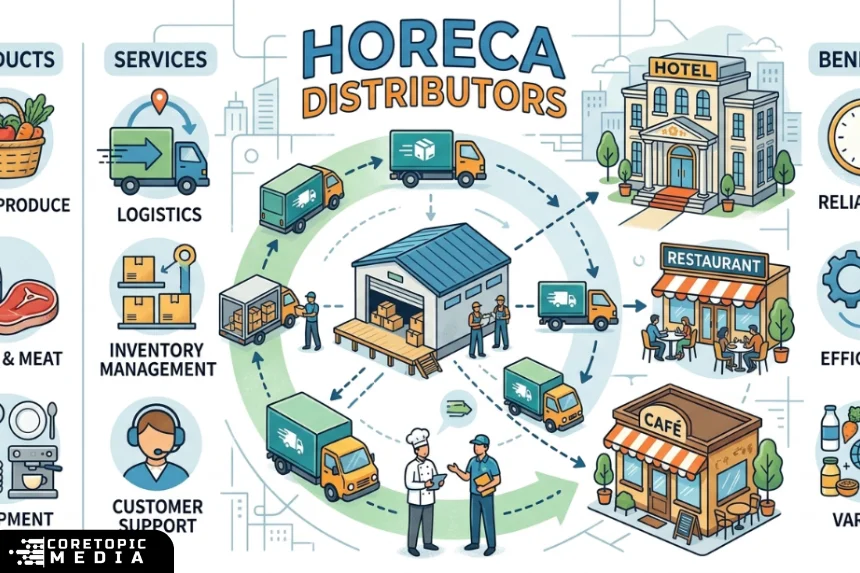
A simple HoReCa supply chain looks like this:
Manufacturer, farm, importer, or brand → HoReCa distributor → hotel, restaurant, café, or caterer → end customer
Plain-language summary: A HoReCa distributor is more than a middleman. The distributor reduces sourcing work, protects product availability, and helps foodservice businesses operate consistently.
How HoReCa Distribution Differs From Retail, Wholesale, and General Trade
HoReCa distribution differs from retail because the buyer is a business, not a household consumer. Hotels and restaurants usually buy larger quantities, order more frequently, need reliable delivery windows, and often require professional formats such as bulk packs, kegs, commercial cleaning products, or chef-grade ingredients.
Retail distribution is designed for shoppers who buy packaged products from supermarkets, convenience stores, or online stores. HoReCa distribution is designed for operators that transform products into meals, drinks, or guest experiences. A consumer may buy a 250g pack of butter; a restaurant may buy commercial cases of butter every week.
Wholesale is broader. A wholesaler may sell in bulk to shops, traders, offices, institutions, or consumers through cash-and-carry. A HoReCa distributor is more specialized because it understands foodservice needs such as delivery slots, kitchen storage limits, menu continuity, emergency orders, substitutions, and invoice credit.
| Channel | Main buyer | Typical order pattern | Delivery model | Main value |
|---|---|---|---|---|
| Retail | Consumers | Small baskets | Customer collects or parcel delivery | Convenience and brand access |
| General wholesale | Businesses or bulk buyers | Bulk purchases | Pickup or delivery | Lower unit cost |
| Cash-and-carry | Small businesses and traders | Bulk but irregular | Buyer collects | Immediate product access |
| HoReCa distribution | Hotels, restaurants, cafés, caterers | Frequent repeat orders | Scheduled outlet delivery | Reliability, service, and assortment |
Plain-language summary: HoReCa distribution is built for professional kitchens and hospitality operators, while retail is built for household shoppers.
What Products Do HoReCa Distributors Supply?
HoReCa distributors supply the products foodservice operators need to run daily operations. These include fresh food, frozen food, dry groceries, beverages, dairy, bakery items, cleaning products, tableware, packaging, disposables, kitchen equipment, and sometimes branded or private-label products.
Food categories usually include meat, seafood, poultry, vegetables, fruit, frozen foods, dairy, flour, rice, sauces, oils, spices, bakery products, desserts, coffee, tea, soft drinks, bottled water, and alcoholic beverages where the distributor is licensed to sell them.
Non-food categories matter too. A hotel or restaurant also needs takeaway packaging, napkins, gloves, bin bags, cleaning chemicals, dishwashing products, paper goods, tableware, small kitchen tools, guest amenities, and sometimes commercial kitchen equipment.
Specialty HoReCa distributors may focus on premium or niche products. Examples include organic produce, halal meat, vegan alternatives, gluten-free bakery items, imported cheese, artisan coffee, specialty seafood, ethnic ingredients, or gourmet desserts.
Plain-language summary: HoReCa distributors usually supply both menu ingredients and operational essentials. The strongest distributors make purchasing easier by giving operators fewer vendors to manage.
How the HoReCa Distributor Business Model Works
The HoReCa distributor business model is based on buying goods at negotiated B2B prices, holding or coordinating inventory, and selling to foodservice operators with a margin. The distributor earns profit by combining product markup, operational efficiency, supplier terms, route density, repeat orders, and value-added services.
The model usually works in five steps.
First, the distributor sources products from manufacturers, farms, importers, beverage companies, equipment suppliers, or local producers. Larger distributors negotiate better prices because they buy in volume. Smaller distributors may compete by offering niche products, local sourcing, faster service, or stronger relationships.
Second, the distributor stores products in the right environment. Dry goods need ambient warehousing. Dairy, meat, seafood, and fresh produce need chilled storage. Frozen products need freezer capacity. Poor storage causes spoilage, rejected deliveries, and food safety risk.
Third, the distributor captures orders. Traditional models use field sales representatives and telesales. Modern models also use B2B ordering portals, mobile apps, WhatsApp ordering, electronic data interchange, or integrated restaurant procurement systems. Repeat order lists are especially valuable because restaurants often reorder the same core items every week.
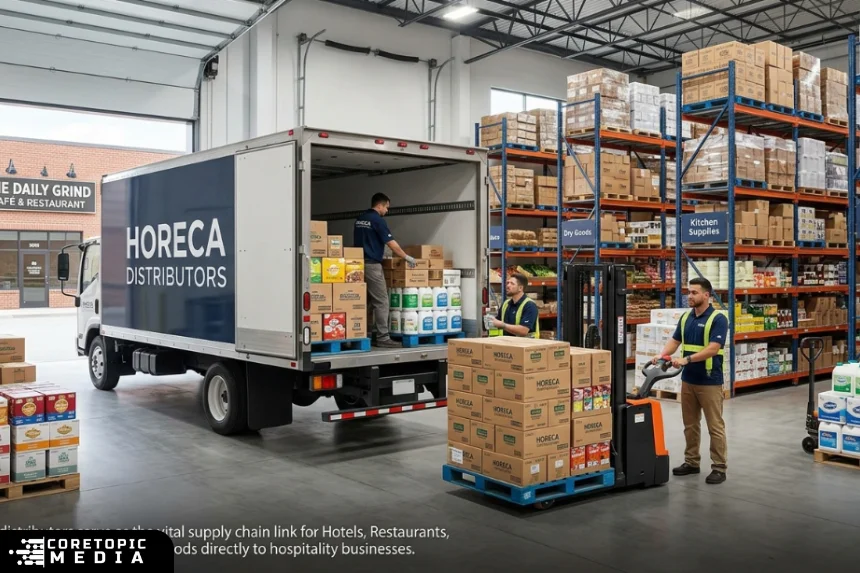
Fourth, the distributor picks, packs, and delivers. Warehouse teams select products, check quantities, prepare invoices or delivery notes, load vehicles, and deliver to outlets within agreed time windows. For refrigerated or frozen products, temperature control is part of the service promise.
Fifth, the distributor manages credit and relationships. Many restaurants and hotels buy on payment terms rather than paying immediately. That creates repeat business, but it also creates working-capital pressure and bad-debt risk if collections are weak.
Plain-language summary: The business model is not just “buy low, sell high.” HoReCa distributors make money when purchasing, inventory, delivery, credit, and customer service work together efficiently.
How HoReCa Distributors Make Money
HoReCa distributors make money mainly from the difference between the purchase price and selling price of goods. Additional profit can come from supplier rebates, private-label products, delivery fees, minimum order charges, equipment leasing, menu support, promotional programs, and financing or credit-related fees.
The primary revenue stream is product margin. The distributor buys a product at a trade price and sells it to a foodservice operator at a higher price. Margin varies by category. Commodity staples are usually more price-sensitive. Specialty ingredients, imported products, premium beverages, private-label goods, and non-food supplies may offer better margin if the distributor has a clear value advantage.
Supplier rebates are another important profit driver. A manufacturer may offer a rebate when the distributor reaches a quarterly volume target, launches a product into new accounts, or supports a promotion. These rebates can improve profitability, but they should not hide weak unit economics.
Private label can also strengthen the model. A distributor may sell its own brand of sauces, frozen vegetables, disposables, cleaning products, or bakery items. Private-label products can create better control over pricing, loyalty, and margin, although they also require quality control and supplier management.
Some distributors earn service revenue. For example, a coffee distributor may lease espresso machines, provide maintenance, train baristas, and sell beans under a supply agreement. A kitchen equipment distributor may provide installation and servicing. These services make the account harder to lose.
Plain-language summary: HoReCa distributors earn through margin and service, but real profit comes from repeat orders, disciplined pricing, supplier terms, and efficient delivery.
Cost Structure and Profit Drivers in HoReCa Distribution
HoReCa distribution is usually a high-volume, low-net-margin business. Profit depends less on a single product margin and more on controlling procurement costs, warehouse productivity, route efficiency, spoilage, labor, fuel, order accuracy, payment collection, and customer retention.
The main costs include product purchasing, warehouse rent, refrigeration, freezer energy, warehouse labor, delivery drivers, fuel, vehicle maintenance, insurance, sales commissions, software, packaging, returns, damaged goods, expired inventory, and unpaid invoices.
Scale matters because delivery is expensive. A truck that delivers large orders to several nearby restaurants is more profitable than a truck driving long distances for small orders. That is why route density, average order value, and minimum order rules are important.
The U.S. foodservice distribution industry shows how large and operationally intensive this model can be. IFDA reports that the U.S. industry posts $382 billion in annual sales, operates about 17,100 locations, runs a combined fleet of 168,300 vehicles, and delivers 12 billion cases to professional kitchens each year. Those numbers show that foodservice distribution is a logistics business as much as a sales business. IFDA also reports a 2.9% median net profit margin for foodservice distribution businesses in 2023, which explains why small operating improvements can have a big impact on profit.
Useful HoReCa distributor KPIs include:
- Fill rate: the percentage of ordered items supplied correctly.
- On-time delivery: deliveries completed inside the promised window.
- Drop size: average order value or cases delivered per stop.
- Route density: number and value of deliveries within a route area.
- Inventory turns: how quickly stock sells and replenishes.
- Shrink or spoilage: stock lost through damage, expiry, theft, or waste.
- Days sales outstanding: how long customers take to pay.
- Gross-to-net margin: margin left after logistics, rebates, returns, and credit losses.
Plain-language summary: A distributor can have strong sales and still lose money if delivery costs, stock waste, or late payments are not controlled.
Main Types of HoReCa Distributors
HoReCa distributors vary by product range, geography, service level, and customer type. The main types include broadline distributors, specialty distributors, beverage distributors, fresh and frozen food distributors, equipment suppliers, regional distributors, and cash-and-carry or hybrid models.
Broadline distributors sell many categories. They may supply dry groceries, frozen foods, fresh produce, dairy, meat, seafood, disposables, beverages, and cleaning products. Large restaurants, hotel groups, institutions, and chains often prefer broadline distributors because they reduce vendor complexity.
Specialty distributors focus on a narrower category. Examples include premium seafood, organic vegetables, artisan bakery, gourmet cheese, specialty coffee, imported ingredients, halal meat, or Asian foodservice products. These distributors win because of product expertise, quality, and supplier access.
Beverage distributors supply soft drinks, coffee, tea, bottled water, juices, beer, wine, spirits, or bar supplies, depending on local laws and licenses. Beverage distribution often includes brand activation, equipment placement, coolers, taps, menu visibility, and promotional support.
Local and regional distributors compete through speed, flexibility, relationships, and local sourcing. They may not match the product range of broadline giants, but they can respond faster and serve independent operators more personally.
Digital-first distributors use online ordering, live stock visibility, app-based account management, and data-driven pricing. Some operate as marketplaces, while others own inventory and logistics.
Plain-language summary: The right distributor type depends on the buyer’s needs. A hotel group may need broadline coverage, while a chef-led restaurant may value a specialist supplier.
Why Hotels, Restaurants, Cafés, and Caterers Use HoReCa Distributors
Foodservice operators use HoReCa distributors because distributors reduce sourcing complexity, consolidate orders, provide reliable delivery, support consistent quality, and simplify purchasing. A restaurant can buy from one distributor instead of managing dozens of separate suppliers, invoices, delivery schedules, and payment terms.
For a busy restaurant, time is part of the cost. If the chef or owner spends hours chasing stock, checking supplier messages, and solving delivery issues, that time is taken away from menu planning, staff training, and customer service. A good distributor removes some of that burden.
Reliability is often more important than the lowest price. If a café runs out of milk before the morning rush, a small price saving does not matter. If a hotel breakfast buffet misses eggs, bakery items, or coffee, the guest experience suffers immediately.
Food safety also matters. The FDA Food Code is a model for protecting food offered at retail and in foodservice, and it emphasizes safe handling and uniform food safety provisions. HoReCa distributors that handle chilled, frozen, or perishable products need strong receiving, storage, transport, and recall processes.
Plain-language summary: Restaurants and hotels use distributors because they need dependable supply, not just cheap products.
Why FMCG and Food Brands Use HoReCa Distributors
FMCG and food brands use HoReCa distributors to reach fragmented foodservice outlets without building a large direct-sales and delivery network. Distributors give brands access to restaurants, cafés, hotels, caterers, and institutional kitchens while supporting local relationships, sampling, promotions, and repeat purchasing.
FMCG means fast-moving consumer goods, such as packaged food, beverages, dairy products, sauces, coffee, snacks, cleaning products, and other frequently purchased items. In HoReCa, these products are not always sold in consumer packs. They may be sold in bulk formats, chef packs, kegs, refill packs, commercial tubs, or back-of-house packaging.
For brands, the HoReCa channel can create trial and visibility. A customer may taste a coffee brand in a café, a sauce in a restaurant, or a beverage in a hotel before buying or requesting it elsewhere. Foodservice placement can influence consumer preference, especially for beverages, desserts, condiments, and premium ingredients.
The trade-off is control. When a brand works through distributors, it may get less direct visibility into outlet-level data, final pricing, product presentation, and customer feedback. Strong distributor reporting and clear agreements help reduce that problem.
Plain-language summary: HoReCa distributors help brands reach many foodservice buyers faster, but brands need the right partner to protect pricing, service quality, and market data.
Challenges in the HoReCa Distributor Business
HoReCa distributors face pressure from thin margins, perishable inventory, fluctuating restaurant demand, fuel and labor costs, late payments, fragmented customers, delivery complexity, food safety obligations, and competition from wholesalers, marketplaces, and direct-to-operator brands.
Perishability is one of the hardest challenges. Fresh produce, dairy, meat, seafood, and bakery items can lose value quickly. Overstocking creates waste, while understocking creates lost sales and unhappy customers.
Demand can change suddenly. Weather, tourism, holidays, weddings, sporting events, local festivals, school calendars, and economic conditions can all affect restaurant orders. A distributor serving cafés may see weekday breakfast patterns, while a distributor serving hotels may face seasonal tourism peaks.
Credit risk is another serious issue. Restaurants often operate with tight cash flow and may ask for 7-day, 15-day, 30-day, or longer payment terms. Credit can win accounts, but weak collection processes can damage the distributor’s working capital.
Traceability and recall readiness are becoming more important. GS1 US says food safety risks exist throughout the supply chain and that product and location identification are critical for seeing where products have been and where they are going. GS1 also notes that standards can support supply-chain visibility, traceability, inventory management, and food safety across foodservice and retail grocery.
Plain-language summary: The hardest part of HoReCa distribution is balancing service quality with cost control. Customers want flexibility, but distributors need discipline to stay profitable.
Technology Trends Changing HoReCa Distribution
Technology is changing HoReCa distribution by improving ordering, inventory visibility, route planning, warehouse productivity, pricing, credit control, and customer retention. The most useful tools are not “AI” in isolation but systems that reduce errors, protect margins, and make repeat ordering easier for operators.
B2B ordering portals help customers place orders without waiting for a sales call. A restaurant can see product lists, negotiated prices, order history, delivery days, and suggested reorders. This reduces missed items and makes purchasing easier.
Distributor management systems and ERP platforms connect purchasing, inventory, sales, invoices, credit limits, warehouse operations, and delivery planning. When these systems work well, sales teams can avoid selling unavailable stock and finance teams can track overdue accounts faster.
Route optimization tools help reduce fuel cost and driver time. Proof-of-delivery tools reduce disputes by recording delivery time, quantities, signatures, photos, or temperature logs.
Forecasting tools are useful for perishable categories. They help estimate how much stock to hold before a holiday, tourist season, event period, or menu change. Forecasts are not perfect, but they can reduce guesswork when combined with customer order history.
Plain-language summary: Technology improves HoReCa distribution when it solves practical problems: fewer stockouts, fewer invoice errors, better routes, faster ordering, and stronger credit control.
How to Choose a HoReCa Distributor
A good HoReCa distributor should match the buyer’s product needs, delivery frequency, service expectations, payment terms, compliance requirements, and growth plans. Price matters, but reliability, fill rate, product quality, returns handling, and account support often matter more for daily foodservice operations.
Use this checklist before choosing a distributor:
- Product range: Does the distributor cover your core ingredients and operational supplies?
- Delivery area: Does the distributor serve your location consistently?
- Delivery frequency: Can the distributor match your prep and storage capacity?
- Minimum order value: Does the minimum order fit your business size?
- Cold-chain process: Can the distributor explain how chilled and frozen items are handled?
- Fill rate: How often are orders completed without missing items?
- Substitution policy: Who approves substitutions?
- Returns policy: How are damaged, expired, or wrong items handled?
- Payment terms: Are credit limits, due dates, and late fees clear?
- Ordering system: Can you reorder easily through an app, portal, email, or sales rep?
- Recall process: Can the distributor trace affected products quickly?
- References: Can existing customers confirm reliability?
Red flags include vague delivery windows, frequent invoice mistakes, unclear temperature-control processes, repeated substitutions without approval, poor communication, and pressure to accept products near expiry.
Plain-language summary: The best distributor is not always the cheapest. The best distributor is the one that protects menu continuity, product quality, and daily operations.
Is HoReCa Distribution a Profitable Business?
HoReCa distribution can be profitable, but it is rarely an easy high-margin business. Profit depends on scale, strong purchasing, route density, inventory control, low spoilage, disciplined credit management, and customer retention. Small distributors usually need a niche or local service advantage to compete.
The model is attractive because customers reorder frequently. Restaurants, cafés, hotels, and caterers need food and supplies every day or every week. Once a distributor becomes part of a kitchen’s routine, the relationship can be sticky.
The model is risky because it requires working capital. Distributors may need to buy inventory before customers pay. They also need warehouses, vehicles, people, systems, and insurance. If stock expires or customers pay late, cash flow tightens quickly.
The broader demand for food-away-from-home supports the importance of this channel. USDA ERS reported that U.S. food-away-from-home spending reached $1.41 trillion in 2025, up from an inflation-adjusted $818 billion in 1997. This does not mean every distributor will profit, but it shows that restaurants and other foodservice outlets remain a large part of food spending.
Plain-language summary: HoReCa distribution can work well when the distributor has repeat customers, efficient routes, tight inventory, and strong collections. Sales growth alone is not enough.
HoReCa Distributor Business Model Example
A typical HoReCa distributor might buy frozen foods, dry groceries, beverages, and disposables from 40 suppliers, store them in a mixed-temperature warehouse, and deliver consolidated orders to 300 restaurants weekly. Profit comes from product margin, delivery efficiency, repeat orders, supplier rebates, and controlled spoilage.
For example, imagine a regional distributor serving independent restaurants and cafés within a 100-mile radius. The distributor carries 2,000 active SKUs, including dry groceries, frozen foods, dairy, packaging, coffee, and cleaning products. Most customers order two or three times per week.
The distributor’s revenue comes from product margin, private-label packaging, supplier promotions, and a small delivery charge for orders below the minimum value. Its biggest costs are inventory purchases, warehouse labor, chilled storage, vehicle fuel, drivers, sales reps, software, damaged goods, and late payments.
The distributor improves profit by increasing average order value, grouping deliveries by route, reducing expired stock, encouraging customers to use reorder lists, and limiting credit for risky accounts. This is why operational discipline matters as much as sales.
Plain-language summary: A HoReCa distributor succeeds when it turns many repeat orders into efficient warehouse and delivery activity.
Key Takeaways
- HoReCa means Hotels, Restaurants, and Cafés or Catering.
- A HoReCa distributor supplies foodservice and hospitality businesses with products they need to operate.
- The distributor business model depends on product margin, logistics, inventory control, credit, and repeat orders.
- HoReCa distribution is operationally complex because customers need reliable delivery and many products are perishable.
- Profitability depends on route density, fill rate, stock control, credit discipline, and customer retention.
- Foodservice operators choose distributors for reliability, assortment, delivery, and service, not just price.
FAQs
What does HoReCa stand for?
HoReCa stands for Hotels, Restaurants, and Cafés or Catering. The term describes businesses that serve food, drinks, hospitality, or guest experiences outside the home.
For example, a hotel breakfast kitchen, a coffee shop, a restaurant chain, and a wedding caterer can all be part of the HoReCa channel.
What is a HoReCa distributor in simple terms?
A HoReCa distributor is a company that supplies hotels, restaurants, cafés, and caterers with food, beverages, equipment, packaging, cleaning products, and other operating supplies.
In simple terms, the distributor helps foodservice businesses buy many products from one reliable supply partner instead of managing many separate suppliers.
Is HoReCa the same as foodservice?
HoReCa and foodservice are closely related, but usage depends on the market. “Foodservice” is common in the U.S., while “HoReCa” is common in Europe, Asia, the Middle East, and FMCG channel planning.
Both terms usually refer to supplying businesses that prepare or serve food and drinks to customers.
What is the difference between HoReCa and retail distribution?
HoReCa distribution sells to businesses such as hotels and restaurants, while retail distribution sells to stores that serve household consumers.
For example, a supermarket sells a small pack of coffee to a shopper, while a HoReCa distributor may sell commercial coffee packs and equipment support to a café.
What products are sold through HoReCa distributors?
HoReCa distributors sell fresh food, frozen food, dry groceries, beverages, dairy, bakery items, cleaning products, packaging, disposables, tableware, and sometimes kitchen equipment.
The product mix depends on the distributor type. A broadline distributor sells many categories, while a specialty distributor may focus only on seafood, coffee, bakery, or premium ingredients.
How do HoReCa distributors make money?
HoReCa distributors make money through product markup, supplier rebates, private-label products, delivery fees, value-added services, and repeat account relationships.
For example, a distributor may earn margin on frozen foods, receive a supplier rebate for reaching a volume target, and charge a delivery fee for small orders.
Are HoReCa distributors profitable?
HoReCa distributors can be profitable, but profitability depends on volume, route efficiency, purchasing terms, inventory control, spoilage reduction, and payment collection.
A distributor with strong sales can still struggle if fuel costs, warehouse waste, invoice errors, or late customer payments are not controlled.
Why do restaurants use distributors instead of buying direct?
Restaurants use distributors because distributors simplify sourcing, combine many products into one order, deliver on schedule, and often provide credit terms.
A restaurant could buy from separate farms, beverage brands, packaging suppliers, and cleaning companies, but that creates more invoices, delivery schedules, and admin work.
What is a broadline foodservice distributor?
A broadline foodservice distributor supplies many categories that restaurants and hotels need, such as dry groceries, frozen food, fresh produce, dairy, meat, beverages, disposables, and cleaning products.
Broadline distributors are useful for operators that want fewer vendors and more consolidated purchasing.
What is the role of cold chain in HoReCa distribution?
Cold chain in HoReCa distribution means keeping chilled and frozen products at safe temperatures during storage, handling, transport, and delivery.
Cold chain is important for products such as dairy, seafood, meat, frozen foods, and prepared items because poor temperature control can damage quality and increase food safety risk.
How do FMCG brands benefit from the HoReCa channel?
FMCG brands benefit from the HoReCa channel by reaching restaurants, cafés, hotels, and caterers that buy frequently and influence consumer tastes.
For example, a beverage brand served in cafés can gain visibility and trial before customers buy it in retail or request it elsewhere.
What software do HoReCa distributors use?
HoReCa distributors commonly use ERP systems, distributor management systems, inventory software, warehouse management systems, route optimization tools, proof-of-delivery apps, CRM platforms, and B2B ordering portals.
The best software setup connects stock, pricing, orders, deliveries, invoices, and customer credit in one workflow.
What should a restaurant check before choosing a distributor?
A restaurant should check product range, delivery reliability, cold-chain capability, fill rate, minimum order value, payment terms, returns policy, substitution rules, ordering system, and customer references.
The distributor should be able to explain how it handles stockouts, urgent orders, damaged goods, and recalls.
Conclusion
HoReCa distributors are the operating link between suppliers and the foodservice businesses that serve customers every day. Their business model depends on reliable sourcing, careful inventory management, efficient delivery, disciplined credit, and strong relationships. If you are evaluating this market, focus less on the idea of “distribution” in general and more on the practical details: product range, delivery density, spoilage control, payment terms, and service reliability.
Discover more on our website about how much do ice road truckers make