

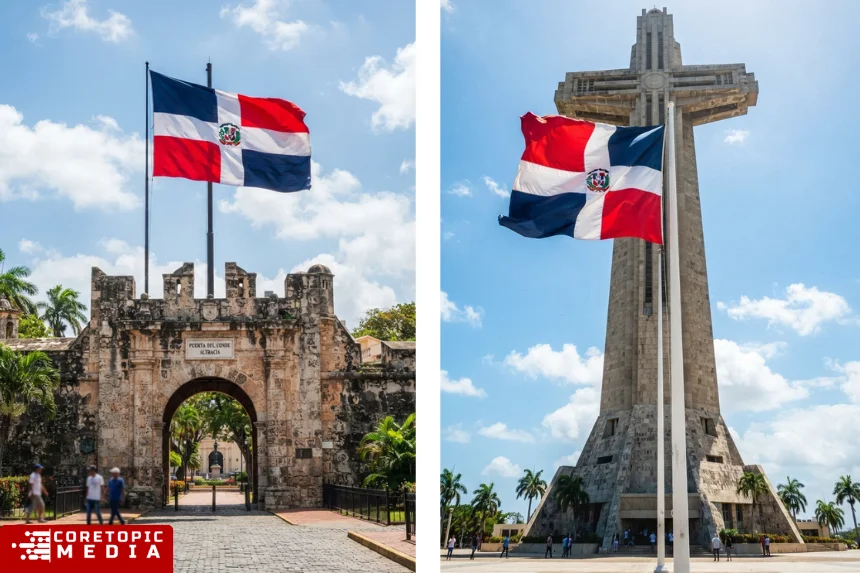
The Dominican flag is the national flag of the Dominican Republic. It features four alternating blue and red sections divided by a bold white cross, with the Dominican Republic’s coat of arms placed at the center. Its official colors are ultramarine blue, vermilion red, and white, and its proportions are 2:3.
The flag dates to the Dominican independence movement led by Juan Pablo Duarte. Its first version flew on February 27, 1844, when the Dominican Republic declared independence, while the country’s first Constitution formally adopted the national flag later that year.
One important distinction comes first: the Dominican Republic flag 🇩🇴 is not the same flag as the national flag of Dominica 🇩🇲. The two Caribbean countries have similar names but entirely different national symbols.
Quick facts about the Dominican flag
| Question | Answer |
|---|---|
| Country | Dominican Republic |
| Dominican flag colors | Ultramarine blue, vermilion red, and white |
| Main design | Four alternating colored quarters divided by a white cross |
| Center symbol | National Coat of Arms |
| Official ratio | 2:3 |
| Designer | Juan Pablo Duarte |
| Design conceived | 1838 |
| First flown | February 27, 1844 |
| Constitutionally adopted | November 6, 1844 |
| National motto | Dios, Patria, Libertad |
| English meaning | God, Homeland, Liberty |
| Bible in coat of arms | Gospel of John, Chapter 8, Verse 32 |
| Merchant version | Similar design without the coat of arms |
| Not to be confused with | Flag of Dominica |
What does the Dominican flag look like?
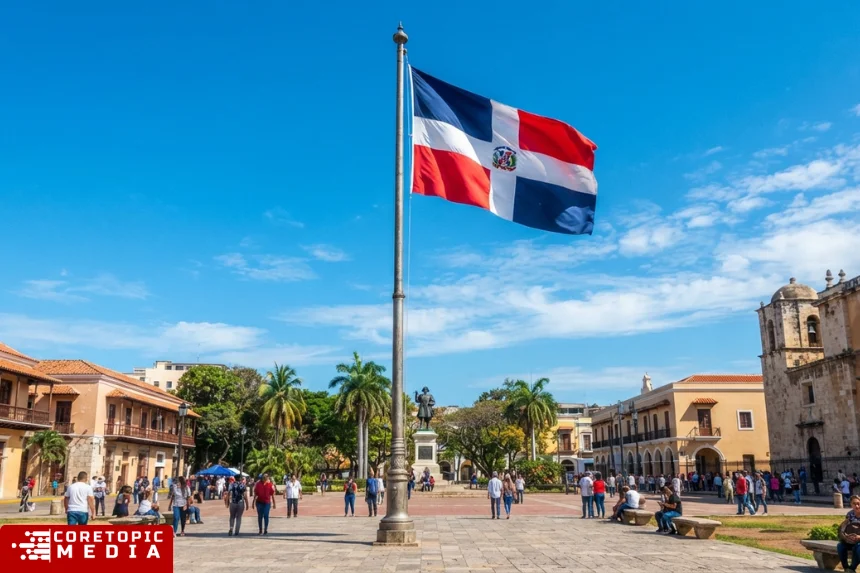
The Dominican flag consists of a white cross stretching to all four edges of a rectangular flag.
The cross divides the field into four quarters. Two quarters are ultramarine blue, while two are vermilion red. The colors alternate rather than sitting in two continuous horizontal bands.
When viewed correctly from the front, the upper quarter nearest the flagpole is blue.
At the center, where the white arms of the cross meet, sits the National Coat of Arms.
The Dominican Constitution specifically defines the alternating red and blue quarters, white cross, and central coat of arms. The Presidency gives the official proportions as 2:3, meaning the flag is three units long for every two units high.
What do the Dominican flag colors mean?
The red, blue, and white colors carry patriotic meanings connected with independence, national unity, faith, and sacrifice.
According to the Presidency of the Dominican Republic:
| Color | Officially attributed meaning |
|---|---|
| Vermilion red | Blood shed by patriots in the struggle for independence |
| Ultramarine blue | The sky over the homeland, God’s protection, and ideals of progress |
| White | Peace and unity among Dominicans |
These interpretations come from the Dominican government rather than from commercial flag sellers.
What does red mean on the Dominican flag?
The vermilion red represents the blood shed by Dominican patriots during the struggle to achieve national independence.
Therefore, the red sections connect the modern flag with the sacrifices made during the creation and defense of the Dominican Republic.
What does blue mean on the Dominican flag?
The ultramarine blue represents the sky covering the homeland.
Official government material also associates blue with God’s protection over the Dominican nation and with Dominican ideals of progress.
What does white mean on the Dominican flag?
The white cross represents peace and unity among Dominicans, according to the Presidency.
Moreover, the cross has deep historical importance because Duarte included it in the original design envisioned during the independence movement.
Why does the Dominican flag have a white cross?
The white cross dates to Juan Pablo Duarte’s original concept for the national flag.
In the oath of the revolutionary organization La Trinitaria, Duarte described a future Dominican flag with red and blue sections crossed by white. Official Dominican sources date this concept to July 16, 1838.
The cross also helped visually separate the new Dominican banner from the flag associated with Haitian rule over the eastern part of Hispaniola.
Today, it remains one of the most recognizable features of the Dominican flag because it extends across the entire height and width of the design.
What is in the center of the Dominican flag?
The center contains the National Coat of Arms of the Dominican Republic.
The emblem is much more detailed than it first appears from a distance.
Article 32 of the Constitution describes an open Bible beneath a cross, surrounded by spears and national flags. A laurel branch appears on one side and a palm branch on the other. Above the shield is a blue ribbon bearing the national motto “Dios, Patria, Libertad.” Below it, a red ribbon reads “República Dominicana.”
In English, the motto is commonly translated as:
God, Homeland, Liberty.
Why is there a Bible on the Dominican flag?
The Bible appears because it forms the centerpiece of the Dominican Republic’s national coat of arms.
The Constitution specifies that the Bible is open to the Gospel of John, Chapter 8, Verse 32.
That biblical passage contains the well-known statement about knowing the truth and the truth bringing freedom.
The Ministry of Foreign Affairs highlights the presence of the Bible as a distinctive feature of the Dominican national coat of arms.
Therefore, when people notice what appears to be a tiny book in the middle of the flag, they are actually seeing a constitutionally defined part of the national emblem.
What does Dios, Patria, Libertad mean?
Dios, Patria, Libertad means God, Homeland, Liberty.
The phrase appears on the blue ribbon above the coat of arms.
It also has roots in the Dominican independence movement. Official government accounts of La Trinitaria show that the words Dios, Patria y Libertad formed part of the identity and ideals of the revolutionary movement associated with Juan Pablo Duarte.
Although English translations sometimes use “Country” or “Fatherland” for Patria, “Homeland” communicates the idea naturally in American English.
Who designed the Dominican flag?
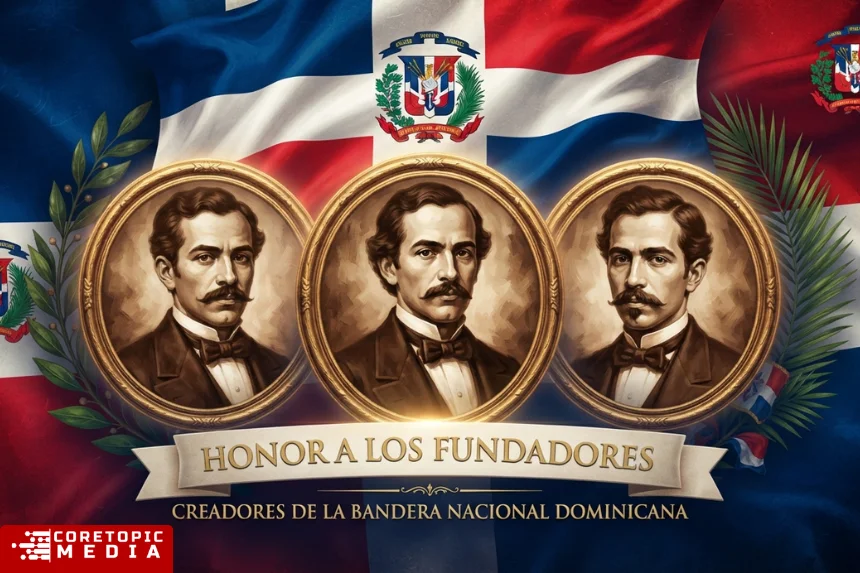
Dominican founding father Juan Pablo Duarte conceived the original design.
The Dominican Ministry of Foreign Affairs says Duarte laid out its form and colors during the Trinitarian oath on July 16, 1838, several years before independence.
The original concept used blue and red with a white cross.
However, the design did not reach its modern arrangement immediately.
The first version differed slightly in the positioning of its colored sections. Later in 1844, the newly established Republic adopted the alternating blue and red quarters found on the national flag today.
Who made the first Dominican flag?
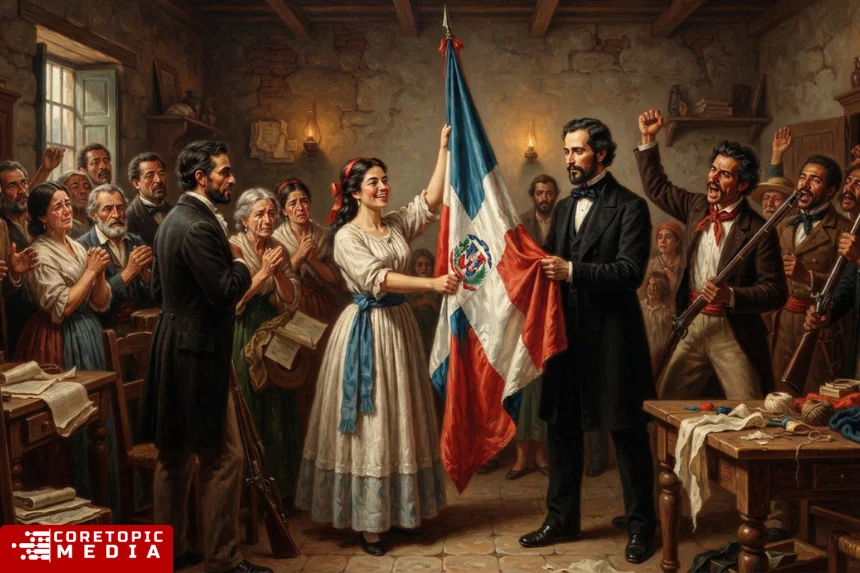
Several Dominican women played an important role in creating the first physical flag.
Government sources identify:
- Concepción Bona
- María Trinidad Sánchez
- María de Jesús Pina
- Isabel Sosa
among the women who helped make the first national flag.
Their contribution connects the flag not only with political leaders such as Duarte but also with the people who physically produced the symbol that would represent the new nation.
When was the Dominican flag first flown?
The first Dominican national flag flew on February 27, 1844.
That date marks the proclamation of Dominican independence.
An official government history says Francisco del Rosario Sánchez and Ramón Matías Mella went to the Puerta del Conde in Santo Domingo, where the new Dominican flag was raised as the independence movement took control.
The Presidency likewise confirms that the first flag flew on February 27, 1844.
Today, February 27 remains the Dominican Republic’s Independence Day.
When was the modern Dominican flag adopted?
The first Constitution formally adopted the national flag on November 6, 1844.
At that stage, the red and blue sections were arranged in alternating quarters, producing the basic layout used today.
The flag’s history can therefore be understood in three key stages:
| Date | Development |
|---|---|
| July 16, 1838 | Duarte’s flag concept appears in the Trinitarian oath |
| February 27, 1844 | First Dominican flag flies during the independence proclamation |
| November 6, 1844 | First Constitution formally adopts the national flag with alternating quarters |
The coat of arms evolved through later versions, but the red-blue-white identity remained central to the flag.
Dominican flag vs. Dominica flag: What is the difference?
The Dominican Republic and Dominica are two separate Caribbean countries, and their flags look completely different.
| Feature | Dominican Republic 🇩🇴 | Dominica 🇩🇲 |
|---|---|---|
| Main colors | Red, white, blue | Green, yellow, black, white, red |
| Background | Four red/blue quarters | Green field |
| Main shape | White cross | Yellow-black-white triple cross |
| Center | National coat of arms | Red disk |
| Animal | None as main flag emblem | Sisserou parrot |
| Stars | None as a ring on the flag | Ten green stars |
| Capital | Santo Domingo | Roseau |
The Government of Dominica describes its flag as a forest-green field with yellow, black, and white cross stripes. A red circular emblem contains the Sisserou parrot surrounded by ten green stars representing the country’s ten parishes.
By contrast, the Dominican Republic uses alternating red and blue quarters, a white cross, and the national coat of arms.
Therefore:
Dominican flag usually means Dominican Republic flag.
Dominica flag means the flag of the Commonwealth of Dominica.
They should never be used interchangeably.
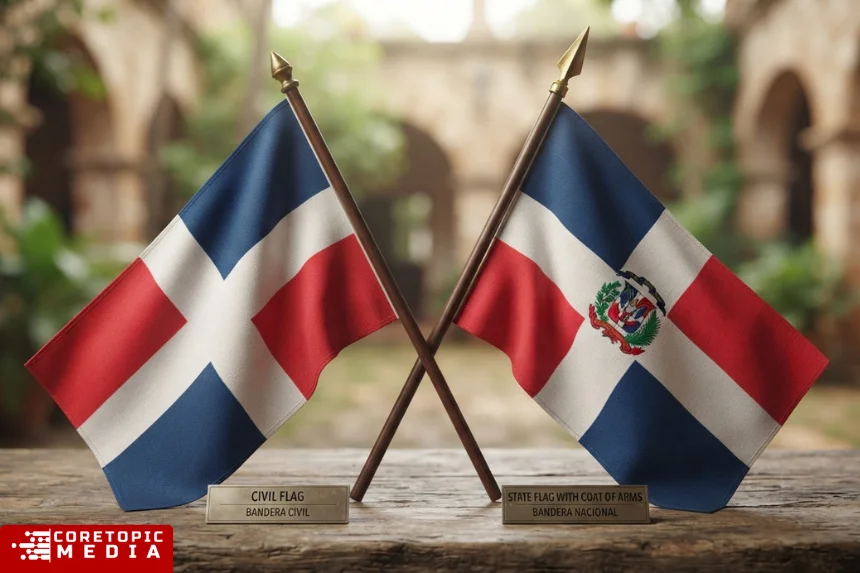
Does every Dominican flag have the coat of arms?
The national flag does, but an official merchant version does not.
The Dominican Ministry of Foreign Affairs explains that the merchant flag follows the same basic pattern as the national flag but omits the National Coat of Arms from the center.
That distinction explains why someone may encounter a red, white, and blue Dominican-style flag without the detailed emblem.
It does not necessarily mean the flag was printed incorrectly.
However, when representing the official National Flag, the coat of arms belongs at the intersection of the white cross.
What is the correct orientation of the Dominican flag?
When displayed normally on a flagpole, the upper quarter beside the pole should be blue.
The Dominican Constitution specifies that blue occupies the upper portion on the hoist side.
Official display guidance also addresses wall mounting.
When the flag hangs horizontally against a wall, the upper blue quarter should appear on the observer’s left when viewing the front of the flag. Government guidance also provides instructions for vertical display, street suspension, funerals, and ceremonial folding.
Correct orientation matters because reversing the red and blue quarters changes the constitutionally defined design.
What are the rules for using the Dominican flag?
Dominican law and official protocol establish standards for respecting and displaying national symbols.
Current Ministry of Foreign Affairs guidance states that the flag should not use colors other than the constitutionally established ultramarine blue, vermilion red, and white. It also prohibits substituting an unofficial version of the coat of arms.
The same guidance says the national flag should not:
- Touch the ground
- Be displayed torn, damaged, or disfigured
- Be inclined as a gesture of reverence
- Be used improperly for political or commercial promotion
- Carry an unofficial version of the national coat of arms
Therefore, accurate reproduction involves more than simply using red, white, and blue.
What is the official ratio of the Dominican flag?
The official proportion is 2:3.
That means a correctly proportioned flag has two units of height for every three units of length.
For example:
- 2 feet × 3 feet
- 4 feet × 6 feet
- 6 feet × 9 feet
all preserve a 2:3 ratio.
The Presidency and Ministry of Foreign Affairs both document that proportion.
However, size alone does not make a reproduction accurate. The white cross, alternating quarters, coat of arms, colors, and orientation also matter.
Dominican flag history timeline
| Year | Event |
|---|---|
| 1838 | Juan Pablo Duarte develops the flag concept for the independence movement |
| July 16, 1838 | The Trinitarian oath records the proposed red, blue, and white design |
| February 27, 1844 | The first Dominican flag flies as independence is proclaimed |
| November 6, 1844 | The first Constitution formally adopts the national flag |
| Later 19th–20th centuries | The national coat of arms undergoes multiple revisions |
| Today | The Constitution defines the red, blue, white, and coat-of-arms design |
Official government accounts provide the strongest evidence for the 1838 concept, the February 1844 first raising, and the November 1844 constitutional adoption.
Why the Dominican flag remains important
The flag brings several parts of Dominican national identity into one design.
Its colors recall independence, unity, faith, and sacrifice. The white cross reflects the independence-era design envisioned by Duarte. Meanwhile, the coat of arms places the national motto and constitutional symbols at the center.
Moreover, the first flag connects modern Dominicans with the women and men who participated directly in the independence movement.
For that reason, the flag functions as more than a national identifier at government buildings or international events. It represents the historical creation, sovereignty, and identity of the Dominican Republic.
Frequently asked questions about the Dominican flag
1. What does the Dominican flag look like?
The Dominican flag has four alternating red and blue quarters divided by a white cross. The National Coat of Arms sits at the center of the cross.
2. What are the Dominican flag colors?
The official colors are ultramarine blue, vermilion red, and white. The Dominican Constitution specifies the blue and red colors and the white dividing cross.
3. What do the colors on the Dominican flag mean?
Red represents the blood shed by independence patriots, blue represents the sky, divine protection, and progress, while white represents peace and unity. These meanings come from official Dominican government guidance.
4. Who designed the Dominican flag?
Juan Pablo Duarte conceived its original form and colors during the Dominican independence movement. His design appeared in the Trinitarian oath in 1838.
5. When was the Dominican flag first flown?
The first national flag flew on February 27, 1844, when Dominican independence was proclaimed. Later that year, the first Constitution formally adopted the national flag.
6. Why does the Dominican flag have a Bible?
The Bible belongs to the National Coat of Arms shown at the flag’s center. The Constitution specifies an open Bible at John 8:32 as part of that emblem.
7. What does Dios, Patria, Libertad mean?
It means God, Homeland, Liberty. The phrase appears on the blue ribbon above the Dominican coat of arms.
8. Is the Dominican flag the same as the Dominica flag?
No. The Dominican Republic uses red, white, and blue with a central coat of arms, while Dominica uses a green field, multicolored cross, red disk, Sisserou parrot, and ten stars.
9. What is the Dominican flag ratio?
The official ratio is 2:3. Therefore, a flag measuring two feet high would be three feet long if it follows the official proportions.
10. Why do some Dominican flags have no coat of arms?
The Dominican Republic has a merchant flag with the same basic color arrangement but without the National Coat of Arms. The official national flag includes the emblem in the center.
Conclusion
The Dominican flag represents the history, sovereignty, and national identity of the Dominican Republic through its distinctive red, white, and blue design.
Juan Pablo Duarte conceived the basic flag during the independence movement. The first version flew on February 27, 1844, and the first Dominican Constitution formally adopted the flag later that year. Today, ultramarine-blue and vermilion-red quarters surround a white cross, while the National Coat of Arms—with its Bible, cross, flags, branches, and Dios, Patria, Libertad motto—occupies the center.
Most importantly, the Dominican Republic flag should not be confused with the green parrot flag of Dominica. They represent separate countries with different histories, designs, and national symbols.
For a broad country overview, readers can also consult Dominican Republic on Wikipedia.