


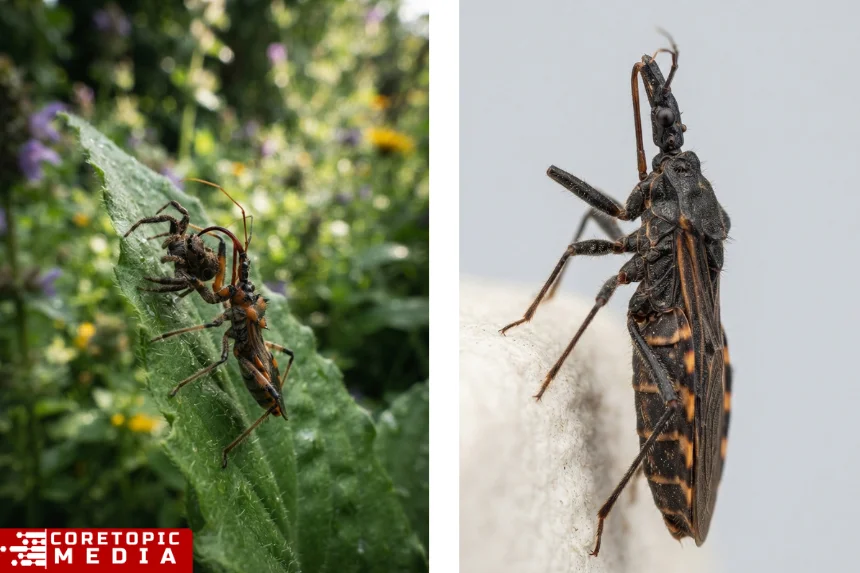
An assassin bug is a predatory true bug in the family Reduviidae. Most assassin bugs hunt other insects and can benefit gardens, although they may deliver a painful defensive bite if handled. Kissing bugs also belong to this family, but they form a specialized blood-feeding group associated with Chagas disease—not the typical predatory assassin bugs people see hunting outdoors.
That distinction matters because the family contains thousands of species with very different appearances and habits. A wheel bug on a tree, for example, belongs to the same family as a kissing bug, yet the two insects do not feed in the same way.
Quick answer: What is an assassin bug?
| Question | Answer |
|---|---|
| What is an assassin bug? | A true bug in the family Reduviidae |
| Scientific family | Reduviidae |
| Main diet | Most species eat other insects and arthropods |
| Typical size | Varies widely; many U.S. species fall around ½–1½ inches |
| Main identification feature | Narrow head with a stout, curved piercing beak |
| Can assassin bugs fly? | Many adults can |
| Do they bite humans? | They may bite defensively if handled or trapped |
| Is the bite painful? | Yes, predatory species can cause immediate pain |
| Do all assassin bugs spread Chagas disease? | No |
| Are kissing bugs assassin bugs? | Yes, they form the subfamily Triatominae |
| Are they beneficial? | Often, because many prey on pest insects |
Assassin bug key facts
| Category | Fact |
|---|---|
| Order | Hemiptera |
| Family | Reduviidae |
| Global diversity | Roughly 7,000 species |
| North American diversity | Close to 200 species north of Mexico |
| Life cycle | Egg → nymph → adult |
| Metamorphosis | Incomplete; no pupal stage |
| Feeding tool | Piercing-sucking rostrum or beak |
| Common groups | Wheel bugs, masked hunters, ambush bugs, thread-legged bugs, kissing bugs |
| Habitat | Gardens, fields, forests, trees, shrubs, and sometimes buildings |
| Human concern | Painful defensive bites; Chagas risk applies specifically to certain infected triatomine bugs |
The NC State Extension assassin bug guide classifies these insects as beneficial predators and explains how they use their beak to immobilize prey.
What does an assassin bug look like?
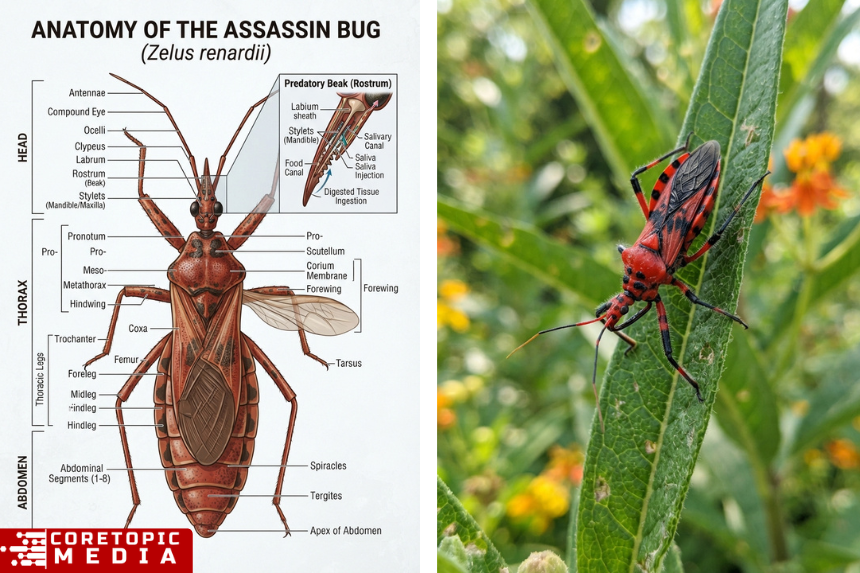
Assassin bugs vary greatly in color and shape, so no single visual description fits every species. However, many have an elongated body, a narrow head, long antennae, and a thick piercing beak that curves beneath the body.
Adults may appear black, brown, reddish, orange, greenish, or patterned. Utah State University reports adult lengths ranging roughly from 4 to 40 millimeters across the family.
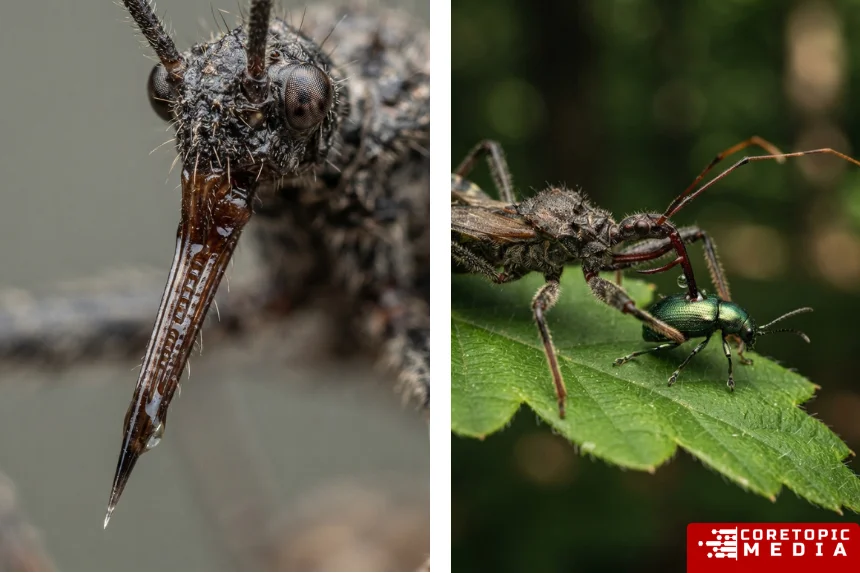
The beak provides one of the most useful clues. Predatory assassin bugs use this stout mouthpart to pierce the exoskeleton of insects.
Meanwhile, adults typically have wings, whereas nymphs lack fully developed wings.
What do assassin bug nymphs look like?
Young assassin bugs often resemble smaller, wingless versions of adults, although their colors can differ.
Some nymphs look surprisingly antlike. Others develop unusual camouflage.
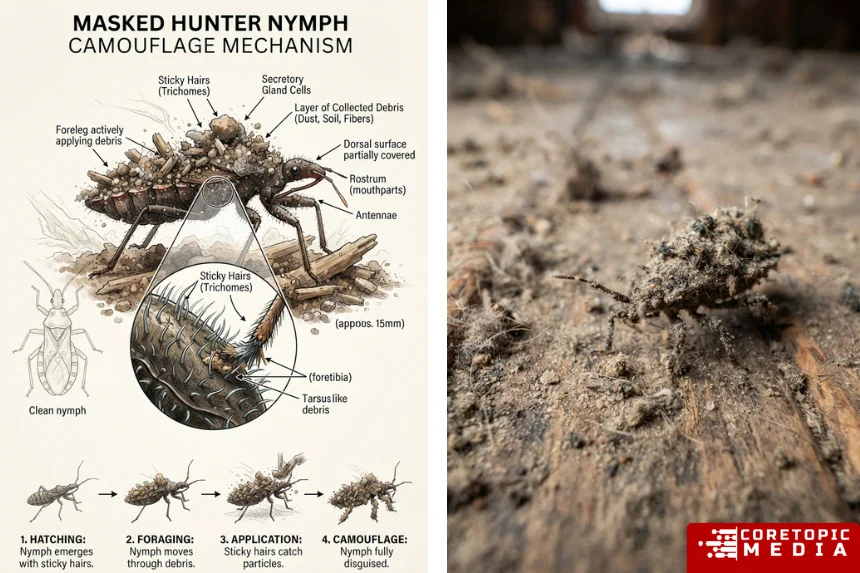
The masked hunter provides perhaps the best example. Its nymph has a sticky body that collects dust, lint, and debris, so it may look like a moving clump of dirt rather than an insect.
The University of Minnesota masked hunter guide explains that the camouflage inspired the insect’s common name.
Why are they called assassin bugs?
The name comes from their hunting method.
Instead of chewing prey, most species stalk it or wait nearby before striking with their piercing mouthparts. They then inject saliva that immobilizes the prey and begins breaking down its tissues.
Afterward, the bug draws the liquefied material through its beak.
Although this feeding style sounds dramatic, it serves an ordinary ecological purpose. Assassin bugs function as predators just as spiders, praying mantises, and predatory beetles do.
What do assassin bugs eat?
Most assassin bugs eat other insects and arthropods.
Their prey can include:
- Caterpillars
- Beetles
- Flies
- Aphids
- Leafhoppers
- Plant bugs
- Grasshoppers
- Other true bugs
However, they do not distinguish between insects that humans consider pests and insects we consider useful.
For example, assassin bugs may also capture bees, lady beetles, or other predators. Therefore, calling them “natural pest control” is reasonable, but calling them selective pest killers would be misleading.
Mississippi State University notes that wheel bugs can attack caterpillars, Japanese beetles, squash bugs, honey bees, and lady beetles.
Are assassin bugs beneficial?
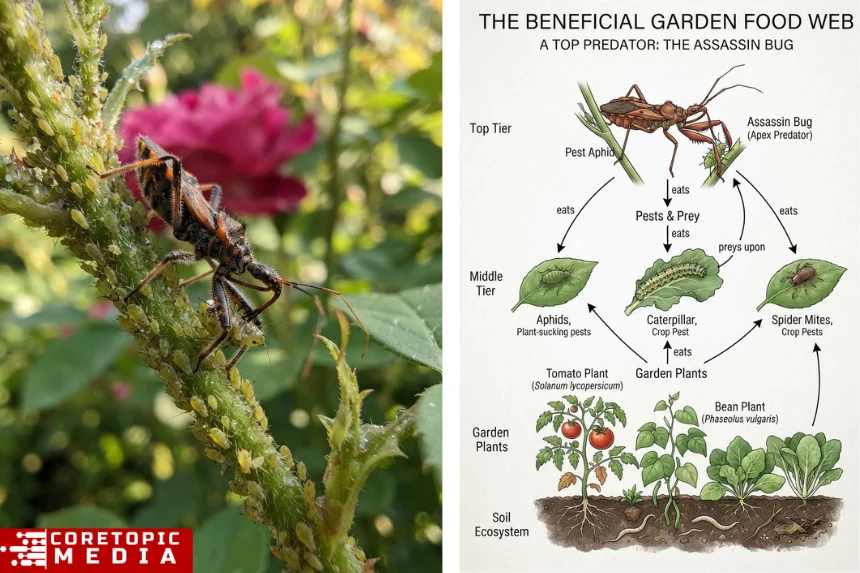
Most predatory assassin bugs can contribute to a healthy garden ecosystem because they eat many plant-feeding insects.
They can help suppress pests without feeding on plants themselves. Consequently, gardeners often leave them alone when they find them outdoors.
However, they rarely act as a complete pest-management solution.
Because assassin bugs are general predators and often occur in relatively low numbers, they may not reduce a major pest outbreak enough by themselves. In addition, indiscriminate pesticide use can kill predatory insects along with the pests.
Therefore, treat assassin bugs as one part of a larger ecological pest-control system rather than a guaranteed biological control program.
Can an assassin bug bite a human?
Yes. Predatory assassin bugs can pierce human skin if they feel threatened.
However, they generally do not seek people as food. Bites commonly happen when someone grabs a bug, crushes it, traps it in clothing, or presses it against the skin.
University of Minnesota Extension says masked hunters may bite when people handle them carelessly. The bite can feel similar to a bee sting and may cause numbness and swelling.
Therefore, the easiest prevention strategy is simple: do not pick up an assassin bug with bare hands.
If one lands on you, stay calm and gently brush it away instead of slapping or squeezing it.
What should you do after an assassin bug bite?
For a typical defensive bite from a predatory assassin bug, clean the area with soap and water and avoid scratching it. Colorado State University recommends disinfecting an insect-bite wound as a precaution against bacterial infection.
A cold compress may help with local discomfort or swelling.
Seek prompt medical attention for trouble breathing, facial or throat swelling, widespread hives, faintness, severe worsening pain, or other signs of a serious allergic reaction.
Most importantly, do not assume that every assassin-bug bite creates a Chagas disease risk.
That concern centers on blood-feeding triatomine, or kissing, bugs.
Health note: This section provides general information, not a diagnosis. A healthcare professional should evaluate serious reactions, unexplained symptoms, or a suspected kissing-bug exposure.
Are assassin bugs poisonous or venomous?
Predatory assassin bugs inject biologically active saliva into their prey, and that saliva helps immobilize and digest the victim.
For humans, the more practical point is that their piercing bite can hurt considerably.
However, “venomous assassin bug” can create confusion when readers interpret it to mean every species poses a major medical hazard. Most assassin bugs do not seek people, and ordinary predatory species do not transmit Chagas disease.
Their defensive bite and the infectious-disease issue require separate explanations.
Is an assassin bug the same as a kissing bug?
No—not exactly.
Every kissing bug belongs to the assassin bug family, but most assassin bugs are not kissing bugs.
Kissing bugs belong to Triatominae, a blood-feeding subfamily of Reduviidae. Predatory groups such as wheel bugs and masked hunters, meanwhile, hunt arthropods rather than taking blood meals from humans.
Colorado State University’s kissing bug and look-alike guide emphasizes this distinction and explains that several harmless or predatory true bugs get mistaken for triatomines.
| Typical predatory assassin bug | Kissing bug |
|---|---|
| Usually feeds on insects | Feeds on vertebrate blood |
| May bite defensively | Takes blood meals |
| Bite often causes immediate pain | Feeding bite may go unnoticed |
| Does not generally transmit Chagas | Infected triatomines can spread T. cruzi |
| Common examples include wheel bug and masked hunter | Includes Triatoma and related genera |
Do assassin bugs spread Chagas disease?
Most assassin bugs do not spread Chagas disease.
The disease concern involves triatomine bugs that carry the parasite Trypanosoma cruzi.
Furthermore, infection does not usually occur simply because an infected bug punctures the skin. According to the CDC guide to Chagas transmission, an infected kissing bug can pass the parasite in its feces after feeding. Infection can occur when contaminated fecal material enters a wound, the eyes, or the mouth.
CDC reported in February 2026 that 11 triatomine species occur in the southern United States. Individual species have different ranges, and not every triatomine carries T. cruzi.
Therefore, seeing a random assassin bug does not mean you have encountered a Chagas vector.
Do kissing bugs live in the United States?
Yes. Several species occur in the United States, particularly in southern and southwestern regions.
The CDC triatomine identification guide provides current distribution information for U.S. species. For example, it documents Triatoma protracta in Arizona, California, Colorado, Nevada, New Mexico, Texas, and Utah, while other species occupy different states.
However, CDC also notes that Chagas disease remains much more strongly associated with rural areas of Mexico, Central America, and South America.
How can you tell an assassin bug from a leaf-footed bug?
Leaf-footed bugs cause frequent identification mistakes because they also have elongated bodies and belong to the true bugs.
However, leaf-footed bugs belong to Coreidae, not Reduviidae.
Many species have widened or leaflike sections on their hind legs. They also feed primarily on plants rather than hunting insects.
Assassin bugs, by contrast, usually show the narrow head and stout, curved predatory beak characteristic of Reduviidae.
Color alone cannot settle the identification. Both families contain brown, black, orange, and patterned insects.
Therefore, look at the legs, head, mouthparts, and overall body structure.
What is a wheel bug?
The wheel bug, Arilus cristatus, is one of the most recognizable North American assassin bugs.
Adults develop a large toothed crest on the thorax that resembles part of a cogwheel or circular saw. That structure makes mature wheel bugs much easier to identify than many other members of the family.
Wheel bugs hunt a wide variety of insects and can grow to around 1.5 inches. Despite their intimidating appearance, they do not hunt people.
However, they can deliver a painful defensive bite if someone handles them.
What is a masked hunter?
The masked hunter, Reduvius personatus, is another assassin bug that people often encounter around buildings.
Adults appear dark brown to nearly black, while nymphs cover themselves in lint and dust for camouflage.
Masked hunters hunt other arthropods and may enter homes, particularly during warmer months. They do not feed on human blood and do not transmit Chagas disease.
Therefore, finding a masked hunter indoors should not automatically trigger the same response as identifying a kissing bug.
Where do assassin bugs live?
Assassin bugs occur in many terrestrial habitats around the world.
Depending on the species, you may find them:
- On trees and shrubs
- In gardens
- In crop fields
- In grasslands
- Around flowers
- In forests
- Beneath bark or debris
- Occasionally inside buildings
They usually concentrate where prey occurs.
Some adults also fly toward lights, which can bring them close to porches, windows, and homes.
Why is an assassin bug in my house?
A predatory assassin bug indoors often wandered or flew inside accidentally.
Open doors, damaged screens, gaps near windows, and outdoor lighting can increase accidental entry. Masked hunters also hunt small arthropods around buildings.
One or two assassin bugs do not necessarily indicate an infestation.
In fact, University of Minnesota Extension notes that masked hunters typically do not reproduce inside buildings and generally require no insecticide treatment.
How should you remove one?
Avoid bare-hand handling.
Instead, place a container over the insect, slide a stiff card underneath, and move it outdoors. A vacuum can also remove a typical predatory assassin bug from an inaccessible area.
However, take greater care if the insect could be a kissing bug. Avoid crushing it with bare skin because triatomine feces may carry T. cruzi.
For suspected triatomines, consult current state or local public-health, extension, or vector-control guidance.
How can you keep assassin bugs out of your home?
Start with physical exclusion.
Repair damaged window and door screens, seal cracks around frames and walls, and reduce unnecessary gaps that allow insects indoors.
For kissing-bug risk specifically, CDC recommends sealing cracks, repairing screens, moving wood and brush piles away from houses, reducing entrances to crawl spaces and attics, and keeping pets indoors at night where practical.
Outdoor lights may also attract various insects, including potential prey and some assassin bugs.
Therefore, keeping bright lights away from entryways can reduce incidental visitors.
Broad pesticide treatment usually makes little sense for an occasional predatory assassin bug. Physical removal and exclusion often solve the problem more directly.
Assassin bug life cycle
Assassin bugs undergo incomplete metamorphosis.
Their development follows three main stages:
egg → nymph → adult
They do not pass through a caterpillar-like larval stage or a pupa.
Nymphs generally resemble wingless versions of adults and grow through several molts. Utah State University describes five nymphal instars before adulthood in predatory true bugs.
Species and climate influence development time, number of generations, and overwintering behavior.
Frequently asked questions about assassin bugs
1. Are assassin bugs dangerous?
Most assassin bugs pose little danger when people leave them alone. However, predatory species can inflict a painful defensive bite, while certain blood-feeding kissing bugs create a separate Chagas disease concern.
2. Do assassin bugs bite humans?
Yes, but most predatory species bite only when threatened, trapped, or handled. Therefore, avoid picking them up with bare hands.
3. Can assassin bugs spread Chagas disease?
Most cannot. Instead, the concern involves infected triatomine, or kissing, bugs whose feces can contain Trypanosoma cruzi.
4. Are assassin bugs and kissing bugs the same?
Kissing bugs are one subgroup of assassin bugs. However, most members of Reduviidae hunt insects rather than feeding on blood.
5. Are assassin bugs good for gardens?
Often yes, because they prey on many plant pests. Nevertheless, they are generalist hunters and may also eat bees and other beneficial insects.
6. What happens if an assassin bug bites you?
A predatory species may cause immediate pain, redness, numbness, or swelling. Clean the area and seek medical help for a severe or systemic reaction.
7. Do assassin bugs fly?
Many adult assassin bugs have functional wings and can fly. Consequently, some may accidentally enter homes or approach lights at night.
8. What is the largest common assassin bug in the United States?
The wheel bug ranks among the largest familiar U.S. assassin bugs and can reach roughly 1.5 inches. Its distinctive cogwheel-like crest makes the adult easy to recognize.
9. Should I kill an assassin bug in my garden?
Usually not. Most species hunt other insects and contribute to natural predator diversity, so leaving an outdoor assassin bug alone generally makes sense.
10. How do I know whether I found a kissing bug?
Do not rely on color alone. Compare the insect’s head, body markings, mouthparts, location, and range with an authoritative identification resource such as the CDC’s U.S. triatomine guide.
Conclusion
An assassin bug belongs to Reduviidae, a diverse family of true bugs known mainly for hunting other insects. Most species benefit ecosystems and pose little concern to people unless someone handles or traps them, which can trigger a painful defensive bite.
The major exception to the usual predatory lifestyle involves kissing bugs, or Triatominae. These blood-feeding assassin bugs can carry Trypanosoma cruzi, and contaminated feces from infected bugs can transmit Chagas disease.
Therefore, do not treat every assassin bug as a disease vector. Learn the difference between predatory species, kissing bugs, and look-alikes such as leaf-footed bugs. In most gardens, an assassin bug is simply another predator doing its job.
Readers seeking a broad taxonomic overview can also consult Reduviidae on Wikipedia, while CDC and university extension sources provide stronger guidance for medical and identification questions.