


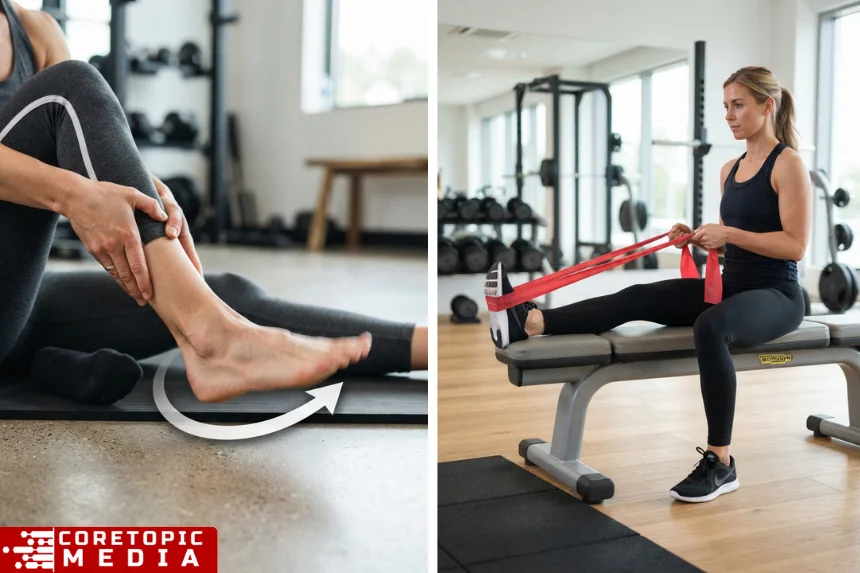
Ankle mobility exercises can help your ankles move more freely, feel less stiff, and support everyday movements like walking, climbing stairs, squatting, running, and changing direction. Good ankle mobility means your ankle can move through its normal range without pinching, sharp pain, or compensation from your knees, hips, or feet.
Your ankle needs both mobility and strength. Mobility helps the joint move well; strength helps control that movement. The American Academy of Orthopaedic Surgeons notes that stretching can help restore range of motion, while strengthening the lower leg, foot, and ankle muscles helps keep the ankle joint stable.
Use the exercises below as a gentle routine, not a test of pain tolerance. If you recently injured your ankle, had surgery, cannot bear weight, or have worsening pain or swelling, speak with a healthcare professional before starting.
What Are Ankle Mobility Exercises?
Ankle mobility exercises are movements that improve how well your ankle bends, points, rotates, and moves side to side. They often target four main ankle actions:
| Movement | What it means | Everyday example |
|---|---|---|
| Dorsiflexion | Pulling your toes up toward your shin | Squatting, walking downstairs |
| Plantar flexion | Pointing your toes away from your shin | Pushing off while walking or running |
| Inversion | Turning the sole of your foot inward | Controlling foot position on uneven ground |
| Eversion | Turning the sole of your foot outward | Resisting an ankle roll |
Bridgewater NHS describes ankle mobility work as exercises intended to help with ankle stiffness during rehabilitation, with the advice to progress at your own pace and stop or seek guidance if symptoms worsen.
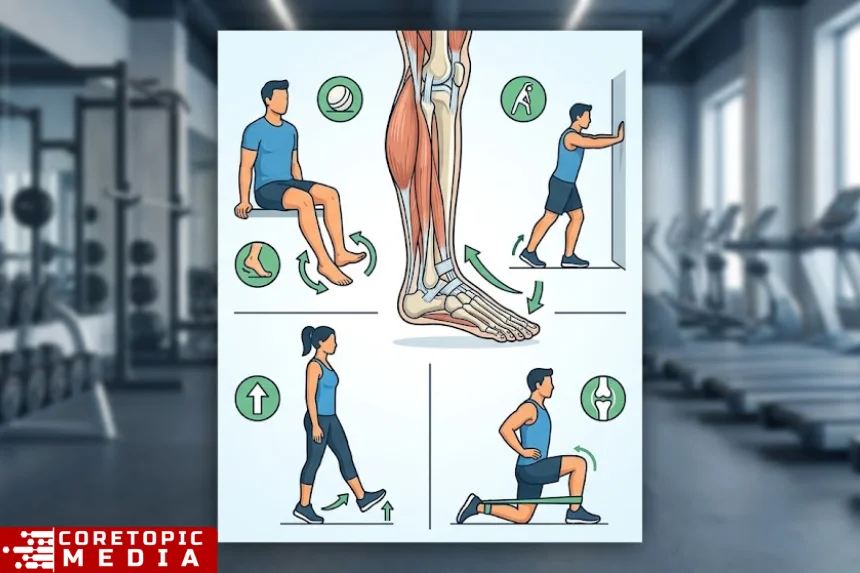
Why Ankle Mobility Matters
Stiff ankles can make simple movements feel harder than they should. Limited dorsiflexion, for example, may cause your heels to lift during squats or make your knees and hips work around the restriction. Poor ankle control can also affect balance, walking mechanics, and confidence on stairs or uneven ground.
Ankle mobility is especially useful if you:
- Feel stiff after sitting, sleeping, or standing for long periods
- Struggle to keep your heels down during squats or lunges
- Feel tightness in your calves or Achilles area
- Are returning to activity after a mild ankle sprain
- Play sports that involve running, jumping, or changing direction
- Want better balance and foot control
A general foot and ankle conditioning program may help people return to daily activities and recreational activity after injury or surgery, but AAOS recommends doing rehabilitation-style programs under a doctor’s or physical therapist’s supervision when recovering from an injury.
Before You Start: Safety Guidelines
These exercises should feel like gentle movement, mild stretching, or controlled muscle work. They should not cause sharp pain, numbness, tingling, or a feeling that your ankle is giving way.
Follow these basic rules:
- Warm up for 5 to 10 minutes with easy walking, cycling, or marching in place.
- Move slowly and stay in control.
- Keep discomfort mild, around 0 to 3 out of 10.
- Stop if pain increases as you continue.
- Use a wall, chair, or counter for balance.
- Progress gradually instead of forcing range.
AAOS advises warming up before foot and ankle exercises, not ignoring pain, and asking a doctor or physical therapist if an exercise does not feel right.
10 Ankle Mobility Exercises to Try
1. Ankle Alphabet
The ankle alphabet is a simple way to move the ankle in many directions without loading it heavily. It works well as a warm-up, early mobility drill, or gentle rehab exercise.
How to do it:
- Sit on a chair or the floor.
- Let one foot hover slightly or rest your heel lightly on the floor.
- Use your big toe to “write” the alphabet from A to Z.
- Move from the foot and ankle, not the hip or knee.
- Repeat once or twice on each side.
Bridgewater NHS recommends writing each letter of the alphabet with the foot and ankle while trying not to move the knee or hip too much. AAOS also includes ankle range of motion using the alphabet, advising small movements led by the big toe.
2. Ankle Pumps
Ankle pumps help with dorsiflexion and plantar flexion. They are easy to do at a desk, on the floor, or before a workout.
How to do it:
- Sit with your heel resting on the floor.
- Pull your toes up toward your shin.
- Then point your toes away as if pressing a gas pedal.
- Move slowly through a comfortable range.
- Do 10 to 20 repetitions per side.
Bridgewater NHS describes ankle flexion and extension pumps as moving the foot up and down like pressing and releasing a car accelerator, starting small and increasing the motion as comfort improves.
3. Ankle Circles
Ankle circles improve general range of motion and help you notice stiffness from side to side.
How to do it:
- Sit or lie down comfortably.
- Lift one foot slightly.
- Slowly circle the ankle clockwise 10 times.
- Circle counterclockwise 10 times.
- Keep the movement smooth and controlled.
Try to move only the foot and ankle. If your knee or whole leg is swinging around, make the circle smaller.
4. Seated Dorsiflexion Raises
This exercise strengthens the muscles at the front of the shin while improving the ability to pull the toes upward.
How to do it:
- Sit in a chair with both feet flat.
- Keep your heels on the floor.
- Lift your toes and the front of your feet toward your shins.
- Pause briefly.
- Lower slowly.
- Do 2 sets of 10 to 15 repetitions.
A Leicester NHS ankle exercise leaflet includes seated ankle dorsiflexion by raising the toes off the floor while keeping the heels down.
5. Seated Plantar Flexion Raises
This movement strengthens the calf muscles and helps with push-off during walking and running.
How to do it:
- Sit with both feet flat on the floor.
- Keep your toes on the ground.
- Lift your heels so you rise onto the balls of your feet.
- Pause briefly.
- Lower slowly.
- Do 2 sets of 10 to 15 repetitions.
Leicester NHS describes seated plantar flexion as raising the heels while keeping the toes on the floor.
6. Wall Calf Stretch
Tight calves can limit ankle dorsiflexion. This stretch targets the gastrocnemius, the larger calf muscle that crosses the knee.
How to do it:
- Stand facing a wall.
- Step one leg behind you.
- Keep the back knee straight and back heel on the floor.
- Point both feet forward.
- Lean gently toward the wall until you feel a calf stretch.
- Hold for 20 to 30 seconds.
- Repeat 2 to 4 times per side.
AAOS recommends a heel cord stretch with the affected leg straight behind, heel flat, and hips pressing toward the wall. Bridgewater NHS gives similar standing calf stretch guidance and advises keeping the heel down and toes facing forward.
7. Bent-Knee Soleus Stretch
The soleus is a deeper calf muscle that can also restrict ankle motion. Bending the back knee shifts the stretch lower toward the ankle and Achilles area.
How to do it:
- Stand facing a wall.
- Step one leg behind you.
- Bend the back knee slightly while keeping the heel down.
- Keep your toes facing forward.
- Lean gently into the stretch.
- Hold for 20 to 30 seconds.
- Repeat 2 to 4 times per side.
AAOS includes a heel cord stretch with the knee bent to target the soleus, noting that the stretch may be felt in the calf, sides of the ankle, and heel.
8. Knee-to-Wall Ankle Mobilization
The knee-to-wall drill is one of the most useful ankle mobility exercises for dorsiflexion. It trains the ankle to bend while the heel stays grounded.
How to do it:
- Stand facing a wall.
- Place one foot a few inches from the wall.
- Keep your heel down.
- Slowly bend your knee toward the wall.
- Let the knee travel over the toes without the arch collapsing.
- Return to the start.
- Do 8 to 12 slow repetitions per side.
If your heel lifts, move your foot slightly closer to the wall. Bridgewater NHS includes a knee-to-wall stretch variation on a step, emphasizing that the heel should stay in contact while the knee moves over the toes.
9. Resistance Band Dorsiflexion and Plantar Flexion
Once basic mobility feels comfortable, resistance bands can build strength through the range you are gaining.
How to do it for dorsiflexion:
- Sit with your leg straight.
- Anchor a resistance band in front of you.
- Wrap it around the top of your foot.
- Pull your toes toward your shin against the band.
- Return slowly.
How to do it for plantar flexion:
- Sit with your leg straight.
- Loop a band around the ball of your foot.
- Hold both ends of the band.
- Point your toes gently against resistance.
- Return slowly.
Do 2 to 3 sets of 8 to 12 repetitions each way. AAOS includes banded ankle dorsiflexion and plantar flexion, recommending controlled movement and a comfortable resistance band.
10. Single-Leg Balance
Mobility is more useful when you can control it. Single-leg balance trains the foot and ankle muscles to stabilize your body.
How to do it:
- Stand near a wall, chair, or counter.
- Shift your weight onto one foot.
- Lift the other foot slightly.
- Hold for 10 to 30 seconds.
- Use light hand support as needed.
- Repeat 3 to 5 times per side.
AAOS includes single-leg balance as part of foot and ankle conditioning, using a stable support surface and holding for up to 30 seconds. Leicester NHS also includes balance exercises as advanced ankle work to improve stability and return to normal activity.
Simple Ankle Mobility Routine
Use this routine 3 to 5 days per week if you are working on general stiffness. Keep it gentle and consistent.
| Exercise | Sets or time |
|---|---|
| Ankle alphabet | 1 round per side |
| Ankle pumps | 15 reps per side |
| Ankle circles | 10 each direction |
| Wall calf stretch | 2 holds per side |
| Bent-knee soleus stretch | 2 holds per side |
| Knee-to-wall mobilization | 10 reps per side |
| Seated dorsiflexion raises | 2 sets of 10 |
| Seated plantar flexion raises | 2 sets of 10 |
| Single-leg balance | 3 holds per side |
AAOS suggests a foot and ankle conditioning program may be continued for 4 to 6 weeks unless a doctor or physical therapist gives different guidance, and that performing exercises 3 to 5 days per week can help maintain foot and ankle strength and range of motion.
How to Progress Safely
Start with seated movements and stretches if your ankle feels stiff or deconditioned. Add standing drills once the ankle tolerates movement well. Strength and balance work should come after basic motion feels comfortable.
A simple progression looks like this:
- Early stage: ankle pumps, circles, alphabet, gentle towel stretch
- Mobility stage: wall calf stretch, soleus stretch, knee-to-wall drill
- Strength stage: calf raises, banded dorsiflexion, banded plantar flexion
- Control stage: single-leg balance, heel raises, slow step-downs
- Sport stage: hopping, cutting, jumping, and running drills under guidance if needed
North Cheshire and Mersey NHS advises that exercise sets and repetitions are only a guide, and people can progress at their own pace as pain and stiffness allow.
Common Mistakes to Avoid
Forcing the Range
Pushing hard into pain can irritate the ankle. Mobility improves better with repeated, controlled movement than with aggressive stretching.
Letting the Heel Lift During Dorsiflexion Drills
If the heel lifts during knee-to-wall work, the ankle is no longer practicing the range you want. Move closer to the wall and keep the heel grounded.
Collapsing the Arch
During standing drills, keep your foot tripod stable: base of the big toe, base of the little toe, and heel. Do not let the arch cave inward.
Skipping Strength Work
Stretching can improve range, but strength helps you control that range. Calf raises, banded ankle work, and balance drills help turn mobility into usable movement.
Doing Too Much After an Injury
If your ankle is swollen, bruised, unstable, or painful with walking, do not rush into advanced mobility drills. An injury may need assessment and a staged rehab plan.
When to Get Medical Advice
Get medical advice promptly if you have severe ankle pain, cannot walk, feel faint or sick from the pain, your ankle or foot looks misshapen, or you heard a snap, grinding, or popping sound at the time of injury. NHS ankle pain guidance lists these as signs that may need urgent advice because they can suggest a fracture or infection.
You should also seek help if:
- Swelling or bruising is large or getting worse
- You cannot put weight on the foot
- The ankle feels very stiff or difficult to move
- Symptoms are not improving with self-care
- The area is hot, red, or you have fever-like symptoms
- You have numbness, tingling, or loss of sensation
- The ankle repeatedly gives way
NHS guidance for sprains and strains recommends getting help when pain worsens, swelling or bruising is significant, weight bearing is difficult, movement is very stiff, symptoms do not improve, or infection symptoms appear.
FAQs
How often should I do ankle mobility exercises?
For general stiffness, 3 to 5 days per week is a good starting point. Some gentle drills, such as ankle pumps or the ankle alphabet, can be done more often if they feel comfortable. AAOS notes that foot and ankle exercises performed 3 to 5 days per week can help maintain strength and range of motion.
What is the best ankle mobility exercise?
The best exercise depends on what is limited. For general stiffness, the ankle alphabet is a good starter. For squat depth and walking mechanics, the knee-to-wall drill is especially useful and for calf tightness, use straight-knee and bent-knee calf stretches.
Can ankle mobility exercises help squats?
Yes, especially if limited ankle dorsiflexion causes your heels to lift or your torso to lean too far forward. Knee-to-wall mobilizations, calf stretches, and controlled dorsiflexion work may help you squat with better ankle motion.
Should ankle mobility exercises hurt?
No. Mild stretching or effort is fine, but sharp pain, increasing pain, numbness, or instability is not. AAOS advises not ignoring pain during exercise and contacting a doctor or physical therapist if you have pain while exercising.
Can I do ankle mobility exercises after a sprain?
Sometimes, but it depends on the severity and timing of the sprain. Mild sprains may benefit from guided range-of-motion work, while more serious injuries may need medical assessment first. Mayo Clinic advises contacting a healthcare professional if you have ankle pain and swelling and think you may have a sprain, because fractures and ligament injuries can overlap.
How long does it take to improve ankle mobility?
Some people feel looser after one session, but lasting improvement usually takes several weeks of consistent work. AAOS describes a general foot and ankle conditioning program as commonly continuing for 4 to 6 weeks unless a doctor or physical therapist gives different instructions.
Conclusion
Ankle mobility exercises work best when they combine gentle range of motion, calf flexibility, strength, and balance. Start with simple drills like ankle pumps, circles, and the ankle alphabet, then progress to knee-to-wall mobilizations, band work, calf raises, and single-leg balance. Keep the movements controlled, stay out of sharp pain, and get medical advice if your ankle is injured, swollen, unstable, or not improving.
Discover more on our website about ant bites on kids