


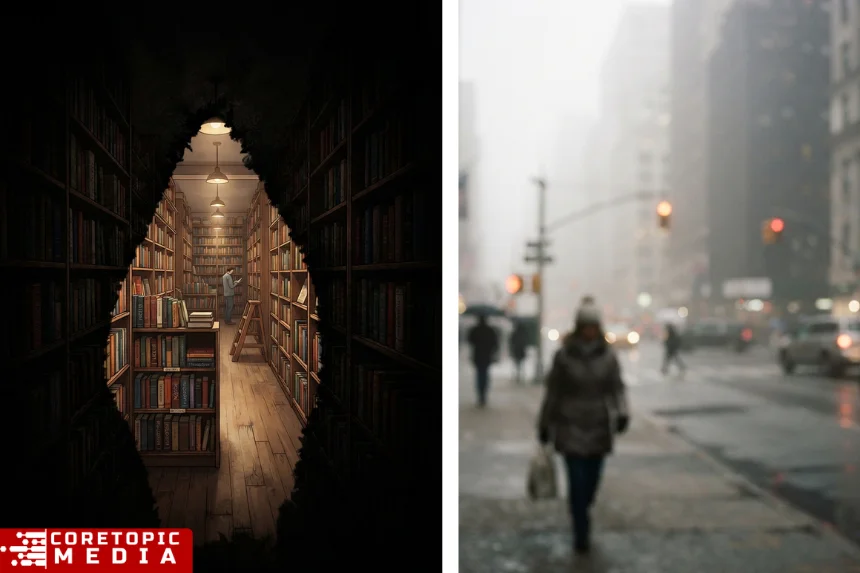
What do blind people see? There is no single answer because blindness covers a wide range of visual experiences. Some blind people can detect light, colors, motion, or large shapes. Others have blurred central vision, narrow peripheral vision, or only small usable areas of sight. People with total blindness have no light perception.
Therefore, the common idea that every blind person experiences a completely black view is inaccurate. Blindness depends on the condition causing the vision loss, how severe it is, when it began, and which parts of the visual system still work.
In addition, legal blindness does not necessarily mean total blindness. A person may qualify as legally blind in the United States while still using remaining vision for navigation, recognizing large objects, or detecting changes in lighting.
Quick answer: What do blind people see?
| Question | Answer |
|---|---|
| What do blind people see? | It varies widely from person to person |
| Do all blind people see black? | No |
| Can blind people see light? | Many can |
| Can blind people see colors? | Some can |
| Can blind people see shapes? | Some can see outlines, movement, or large forms |
| Does legal blindness mean no sight? | No |
| What is total blindness? | No light or form perception |
| Can blind people dream visually? | It depends partly on when vision loss began |
| Can blindness cause visual hallucinations? | Yes, in conditions such as Charles Bonnet syndrome |
| Can blind people use remaining vision? | Yes, many use residual vision together with other senses and technology |
Blindness does not look the same for everyone
Blindness is a spectrum rather than one uniform visual condition.
The National Eye Institute describes several forms of low vision, including loss of central vision, loss of peripheral vision, difficulty seeing in low light, and blurry or hazy vision. Therefore, two people who both describe themselves as blind may experience completely different visual worlds.
For example, one person may clearly detect daylight but not recognize faces. Another may see sharp details in the center while missing almost everything to the sides. Someone else may see only vague movement or large contrasting shapes.
Consequently, asking a blind person what they personally see usually gives a more accurate answer than relying on a single simulation.
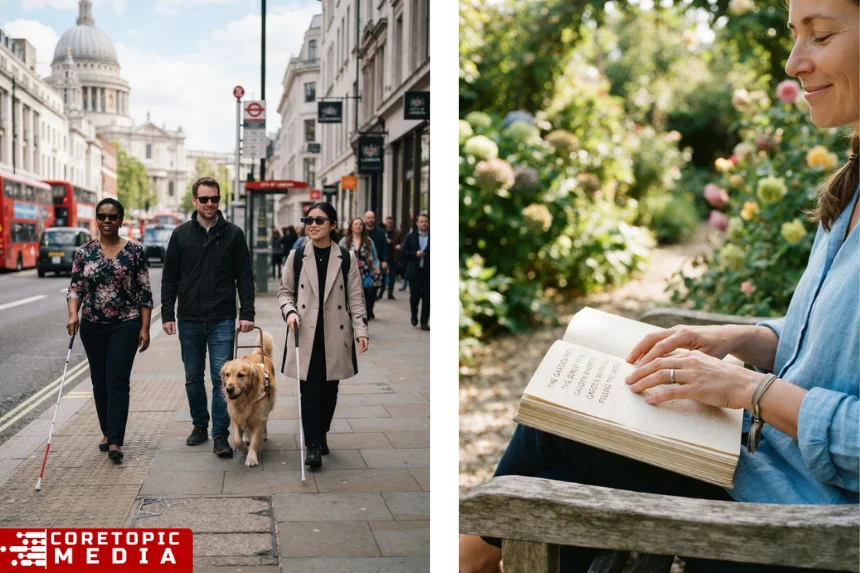
Do blind people see black?
Not necessarily.
The idea that blindness feels like closing your eyes and looking at darkness works poorly as a universal comparison. Closing your eyes still involves a visual system that has experienced light, color, and darkness.
The American Foundation for the Blind’s explanation of blindness and low vision notes that the stereotype of blindness as constant blackness generally does not reflect how vision loss works. Many people retain light perception or other usable sight.
Moreover, “black” is itself a visual concept. For someone born with no light perception, saying that they “see black” may not meaningfully describe their experience because they did not first experience black as a visual color and then lose everything else.
Therefore, no visual input offers a more careful description of total blindness than “seeing darkness.”
What does total blindness look like?
Total blindness means a complete lack of light perception and form perception.
Eye-care professionals may record this as NLP, meaning “no light perception.” Someone with NLP does not detect whether a lamp turns on, whether daylight enters a room, or whether an object moves in front of the eyes through ordinary vision.
However, subjective experience can still vary.
For example, some people with severe or total vision loss report flashes, patterns, or internally generated imagery. Those experiences do not necessarily mean the eyes are detecting external objects.
Instead, the visual system or brain can sometimes generate sensations without incoming visual information.
Therefore, total blindness should not be reduced to a picture of a black screen.
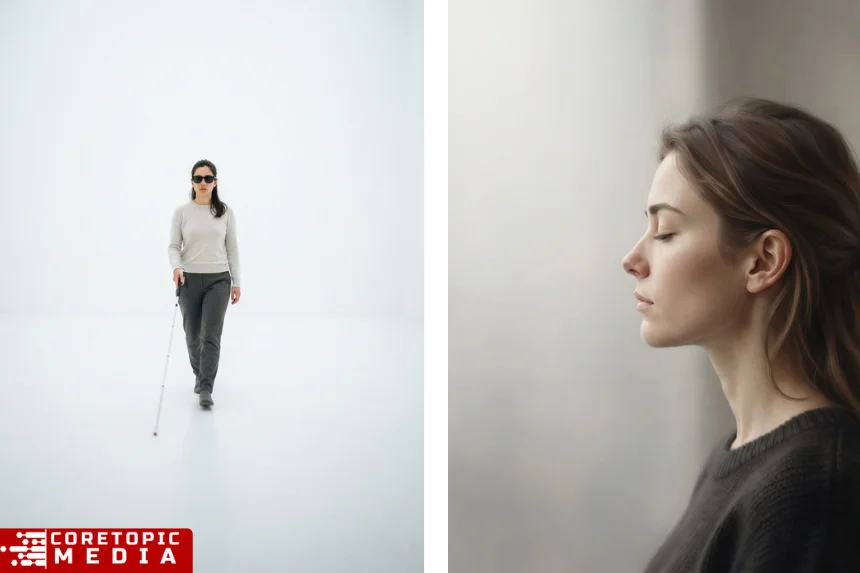
What does light perception mean?
Light perception means that a person can detect light even when they cannot see useful detail.
For example, a person might notice that:
- A room light has turned on
- Sunlight is coming through a window
- A bright screen is nearby
- A camera flash occurred
- Light comes from a particular direction
However, that person may not see the lamp, window, phone, or camera itself.
The American Foundation for the Blind distinguishes simple light perception from light projection, which can include recognizing the general direction of a light source.
Consequently, someone can accurately identify themselves as blind while still noticing changes between bright and dark environments.
What can legally blind people see?
A legally blind person may still have substantial residual vision.
In the United States, the Social Security Administration uses a specific statutory definition. A person can qualify with best-corrected central visual acuity of 20/200 or less in the better eye. Alternatively, a visual field of 20 degrees or less can meet the standard.
The Social Security Administration definition of statutory blindness therefore describes a measurement threshold rather than complete absence of vision.
For example, someone with severely restricted peripheral vision may still see details directly ahead. Similarly, someone with 20/200 ahead. Similarly acuity may see large objects but lack the sharpness needed to read ordinary print from a normal distance.
Therefore, “legally blind” should never be treated as a synonym for “sees nothing.”
What do different types of blindness look like?
The specific pattern depends heavily on the underlying eye or neurological condition.
| Type of visual loss | Possible experience |
| Central vision loss | Missing, blurred, or distorted details in the center |
| Peripheral vision loss | Narrow or tunnel-like usable field |
| Blurry or hazy vision | Objects remain visible but lack clarity |
| Reduced contrast | Objects blend into backgrounds |
| Night blindness | Major difficulty in dim environments |
| Light perception only | Awareness of brightness without useful detail |
| No light perception | No ordinary visual detection of light or form |
The National Eye Institute identifies central loss, peripheral loss, night blindness, and blurred or hazy vision among major formturn758465view2
However, even these labels do not capture every individual experience. People can have several patterns at once, and the amount of usable vision may change with lighting, fatigue, contrast, distance, or environment.
Can blind people see colors?
Some blind people can see color.
A person with partial vision may perceive colors clearly, faintly, or only under strong lighting. Another person may see large areas of color without being able to identify shapes or objects.
Meanwhile, some eye conditions reduce contrast or color discrimination even before they eliminate other forms of sight.
Therefore, blindness does not automatically mean a black-and-white visual world.
People who previously saw normally may also remember colors after losing sight. They can still understand red, blue, green, and other colors through visual memory even when they can no longer detect them through the eyes.
Someone born totally blind, however, may understand color through language, association, symbolism, temperature, emotion, or culture rather than through a remembered visual sensation.
What do people born blind see?
Someone born with total blindness and no light perception does not begin life with a normal visual scene that later disappears.
Therefore, “everything turned black” does not accurately describe congenital blindness.
Instead, that person builds knowledge of the world through touch, sound, movement, smell, language, spatial relationships, and other available information.
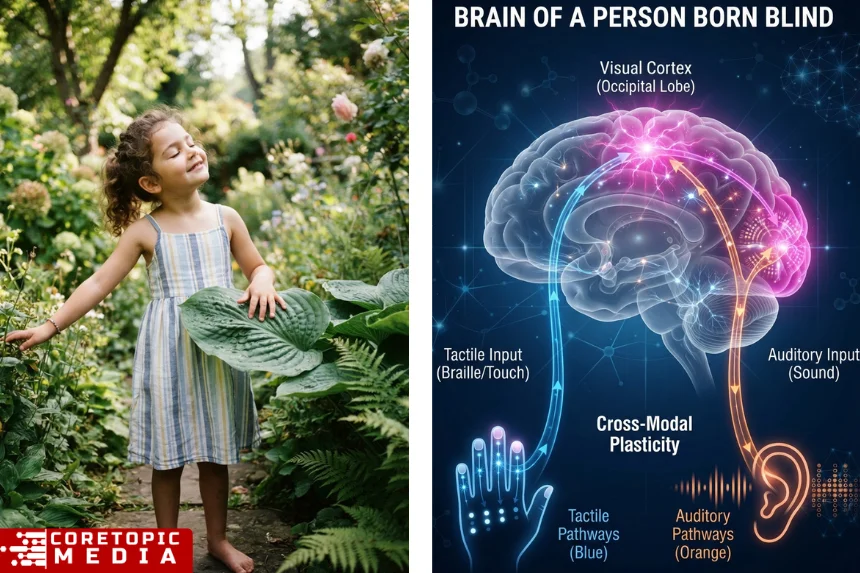
Moreover, the brain can adapt to the absence of sight. Research on blindness shows that brain regions usually associated with visual processing can participate in tasks involving touch, hearing, language, and sensory substitution. This neuroplasticity does not mean blind people automatically gain “super hearing.” Instead, the brain learns to make efficient use of the information available to it.
Public understanding often focuses too much on what a blind person lacks. However, perception involves much more than vision alone.
What about people who become blind later in life?
Acquired blindness can create a different subjective experience because the person already has visual memories.
Someone who loses sight in adulthood may remember faces, colors, places, printed letters, landscapes, or visual scenes. Therefore, visual imagination can continue even after external sight becomes severely limited or disappears.
The exact experience depends on the cause, speed, and extent of vision loss.
For example, progressive eye disease may leave useful islands of vision for years. Meanwhile, an injury or neurological condition may cause a sudden and very different change.
In addition, people who lose vision later may continue to picture familiar objects mentally. Memory does not vanish simply because the eyes can no longer supply the same information.
Do blind people dream in pictures?
Blind people dream, but dream content varies.
People who lose sight after years of normal vision often report visual imagery in dreams. Their brains can draw on stored visual memories, although the amount and clarity of visual content may change over time.
Research involving congenital and early blindness gives a more complicated picture. One study found that congenitally blind participants reported more sound, touch, taste, and smell in dreams than sighted participants and fewer visrn460646search18
However, scientists still debate how to classify visuo-spatial dream experiences in people who have never had ordinary sight. A 2023 systematic review found that research methods and conclusions varyrn460646search19
Therefore, the safest answer is not “blind people do” or “blind people do not” dream visually.
Instead, dream experience depends strongly on visual history, type of blindness, and how researchers define visual imagery.
Can blind people see things that are not there?
Yes, some people with vision loss experience visual hallucinations.
One important example is Charles Bonnet syndrome, which can occur when significant vision loss reduces normal visual input. The brain may then generate vivid visual experiences such as shapes, faces, animals, objturn758465view3
People with Charles Bonnet syndrome typically maintain insight that the images are not real. Therefore, the condition differs from hallucinations caused by many psychiatric or cognitive disorders.
The National Library of Medicine overview of Charles Bonnet syndrome explains that it can accompany conditions such as macular degeneration, glaucoma, diabetic retinopathy, retinal detachment, and optiturn758465view3
However, new visual hallucinations deserve medical assessment because several neurological, medication-related, psychiatric, and eye conditions can also cause them.
Are flashes of light the same as seeing normally?
No.
People can experience flashes, sparks, geometric forms, or other visual sensations even when ordinary vision is severely reduced.
These phenomena may come from the retina, optic nerve, or brain rather than from seeing an external light source.
For example, retinal problems can cause sudden flashes or new floaters. Therefore, a person should not automatically assume that unexplained flashes simply reflect blindness.
The National Eye Institute warns that a sudden increase in floaters, flashes, or a curtain-like shadow can indicate retinal detachment, which requires ururn748314search0
Medical safety note: This article provides general information, not a diagnosis. Sudden vision loss, new flashes or floaters, severe eye pain, or new unexplained visual hallucinations should prompt professional medical evaluation.
Does blindness mean someone cannot use vision at all?
No.
Many blind people make active use of residual vision.
For example, someone may use:
- Large print
- High contrast
- Bright or carefully controlled lighting
- Magnification
- Screen enlargement
- Color cues
- Peripheral viewing
- Remaining central vision
The National Eye Institute guide to low vision explains that vision rehabilitation, magnification, environmental changes, and accessibility settings can help people make better use of turn758465view2
Therefore, a blind person reading a phone screen, recognizing a large object, or moving without a cane does not mean the person is “not really blind.”
Blindness describes visual impairment, not a required set of behaviors.
How do blind people understand their surroundings?
People use many sources of information to understand space.
Vision is only one of them.
A blind person may use hearing to locate traffic, voices, doors, or echoes. Touch can provide information through a cane, hands, feet, Braille, or environmental surfaces. Meanwhile, memory helps organize familiar spaces.
In addition, smartphones, GPS navigation, screen readers, object-recognition tools, audio descriptions, tactile markings, and other technologies can provide information that sighted people often obtain visually.
However, blind people do not automatically develop supernatural senses.
Instead, practice, attention, experience, training, and neuroplasticity can make nonvisual information more useful.
Can blindness change over time?
Yes.
Some causes of vision loss remain stable, while others progress or fluctuate. In addition, treatment may prevent further loss or improve certain aspects of vision depending on the underlying condition.
The World Health Organization identifies refractive errors, cataracts, diabetic retinopathy, glaucoma, and age-related macular degeneration among major global causes of visual impairmenurn460646search0
Consequently, the phrase “blind person” does not reveal when vision loss started, whether it will change, or whether treatment can help.
An eye-care professional needs to evaluate the underlying cause.
Why visual simulations have limits
Images that simulate glaucoma, macular degeneration, cataracts, or tunnel vision can help sighted readers understand broad visual patterns.
However, they remain approximations.
A screenshot with a black circle in the middle does not perfectly recreate central vision loss. Similarly, darkening the sides of a photograph cannot fully reproduce how the brain interprets a restricted visual field.
Moreover, many people adapt to progressive vision loss over years. Their perception does not necessarily feel like continuously staring through a digital filter.
Therefore, simulations work best as educational illustrations rather than literal representations of what every blind person sees.
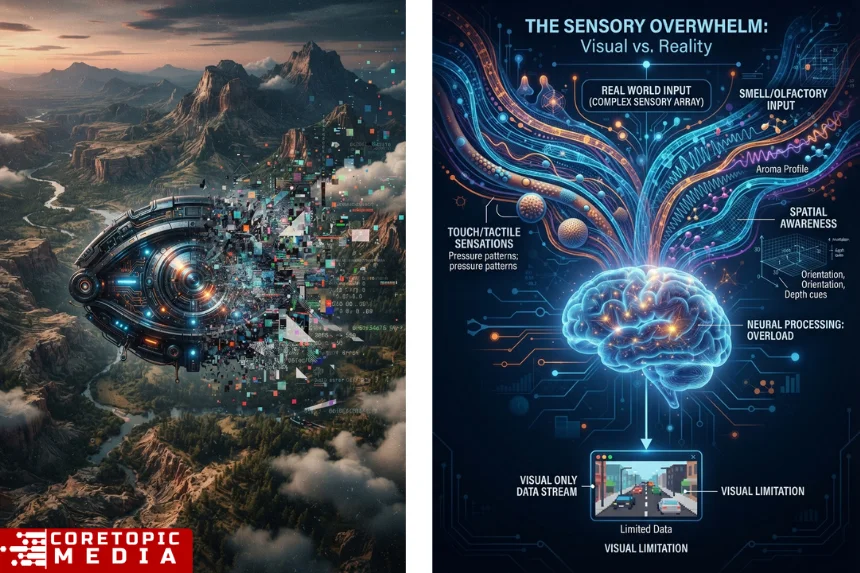
What does “blind” actually mean in everyday life?
The word covers several overlapping medical, legal, and personal meanings.
A doctor may describe the severity and pattern of vision loss. The U.S. government uses specific numerical criteria for statutory blindness. Meanwhile, an individual may identify as blind because vision loss substantially affects daily life even when some residual sight remains.
The American Foundation for the Blind notes that legal categories do not explain functional ability very well. Two people with similar acuity measurements may use their vision differentlturn758465view1
Therefore, respectful language starts with understanding that blindness has many forms.
Readers seeking a broad background overview can also consult blindness on Wikipedia, although medical questions should rely on eye-care professionals and authoritative health sources.
Frequently asked questions about what do blind people see
1. What do blind people see?
Blind people can experience many different forms of vision. Some see light, colors, movement, blurry objects, or restricted parts of a scene, while people with total blindness have no light perception.
2. Do blind people just see black?
No. That description does not fit most forms of blindness, and it can be especially misleading for someone born without sight. Instead, blindness can range from partial usable vision to no visual input.
3. Can blind people see light?
Yes, many blind people can detect light. For example, they may know whether a room is bright or dark even when they cannot identify objects.
4. Can legally blind people still see?
Yes. Legal blindness describes visual acuity or visual-field limits rather than total absence of sight. Therefore, a legally blind person may still use substantial remaining vision.
5. Do people born blind know what colors look like?
Someone born with total blindness can understand colors as concepts, associations, or language, but they do not have the same remembered visual color experience as someone who once had sight.
6. Do blind people see in their dreams?
It varies. People who lose sight later often retain visual dream imagery, while congenital blindness tends to produce stronger nonvisual dream content; however, research on visual-like imagery in congenital blindness remains debated.
7. Can blind people hallucinate visually?
Yes. For example, Charles Bonnet syndrome can cause visual hallucinations in people with significant vision loss. Nevertheless, new hallucinations should receive medical evaluation because several conditions can cause them.
8. Can a totally blind person see flashes of light?
Some people report internally generated flashes or patterns even when they have little or no usable sight. However, flashes can also signal an eye problem, so sudden new symptoms deserve prompt evaluation.
9. Do blind people have better hearing?
Not automatically. Instead, many blind people develop greater skill at interpreting sound because they rely on it more often, and the brain can adapt through experience and neuroplasticity.
10. Can blindness look different from day to day?
Yes. Lighting, contrast, fatigue, glare, disease progression, and the underlying eye condition can change how useful a person’s remaining vision feels in different situations.
Conclusion
What do blind people see? The accurate answer is that blindness has no single visual appearance. Some blind people see light, colors, movement, blurry forms, or restricted portions of the visual field, while others have no light perception.
Moreover, legal blindness does not mean total blindness, and congenital blindness differs from losing sight later in life. Dreams, visual memories, residual sight, and even hallucinations can also vary between individuals.
Ultimately, the best way to understand blindness is to move beyond the image of a black screen. Vision loss exists on a spectrum, and each person’s experience depends on their eyes, brain, medical condition, history, and remaining visual function.